


The Marriage of Figaro review


Louisa Muller’s original approach freshens up Mozart’s classic comedy


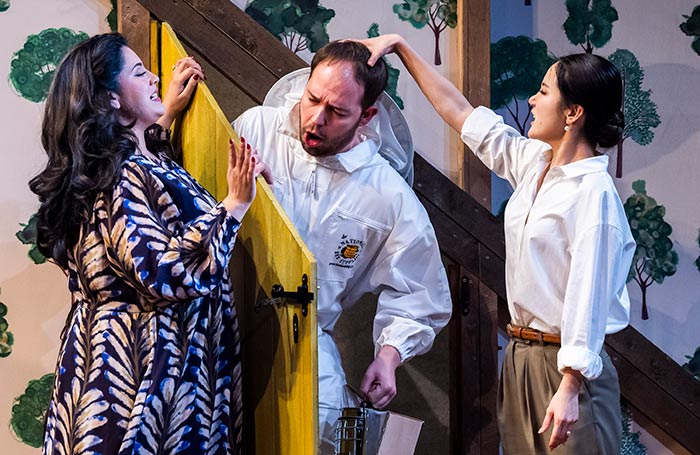
Louisa Muller’s detailed, insightful production of Mozart’s classic comedy moves the action from 18th-century Spain to England in the present day. The castle owned by the Almavivas is a somewhat dilapidated English country house; when it rains during the festivities for the multiple weddings in Act III, some of the characters are carrying buckets to catch the rain coming through the roof.
Nevertheless, all the textual references to Spain, Seville, and to Count Almaviva being appointed ambassador to London are retained in this Italian-sung performance.
And how well sung it is. Every member of the cast, from top to bottom, offers vocal excellence and an instrument ideally suited to their individual character. None is more lovely than Gabriella Reyes’ liquid, ample soprano as the Countess, although both Hera Hyesang Park’s charming, sparky Susanna (here the Countess’ assistant rather than maid) and Hongni Wu’s sexually precocious Cherubino match her in sheer quality. Of the leading men, James Newby’s Count is a mess of anger and sexual frustration, voiced with tensile strength; the far more bonhomous Figaro is given dimensionality and bass-baritonal richness by Liam James Karai.
Expertly delivered are secondary roles such as Jonathan Lemalu’s complex Dr Bartolo, Daniel Norman’s thought-through music teacher/intriguer Basilio, Charlotte Bowden’s innocently savvy Barbarina, Jamie Woollard’s dumb, persistent gardener Antonio and Kamil Bień’s flummoxed lawyer Don Curzio. Excellent throughout, Katherine Broderick’s Marcellina deserves a particular mention for showing what a singer can do with a single word: on recognising to her amazement Figaro as her long-lost son, her imaginatively coloured singing of his name – “Raffaello" – is infinitely touching.
Continues...
Read More
But this is a production in which the humanity of the characters and their truthful interactions reach the highest standard. In classic works, artists and audiences are accustomed to seeing situations in a time-honoured light; here, everything has been minted anew. In Act IV, a nocturnal garden scene replete with disguises and general confusion is far clearer than usual, partly due to designer Madeleine Boyd’s stables setting and Malcolm Rippeth’s clean lighting. Mozart’s opera registers as even better than one remembers.
There’s strong work from Opera North’s vital chorus and keenly focused orchestra, with conductor Valentina Peleggi drawing fine balance from all involved in the overall sound picture – although other productions present more of the vocal decoration that we know Mozart and his singers would have volunteered. And in the final act, there are a handful of moments when pit and stage are not quite together. But this will undoubtedly be tidied up as the run continues at the Grand and on the company’s tour, when audiences will encounter a truly special experience. Good to see so many young people among them on the first night.
For full tour dates and venues, go to: operanorth.co.uk
For all the latest theatre reviews, sign up to The Stage’s weekly reviews newsletter
Most Read
Across The Stage this weekYour subscription helps ensure our journalism can continue
Invest in The Stage today with a subscription starting at just £7.99

© Copyright The Stage Media Company Limited 2026


