


The Battle review


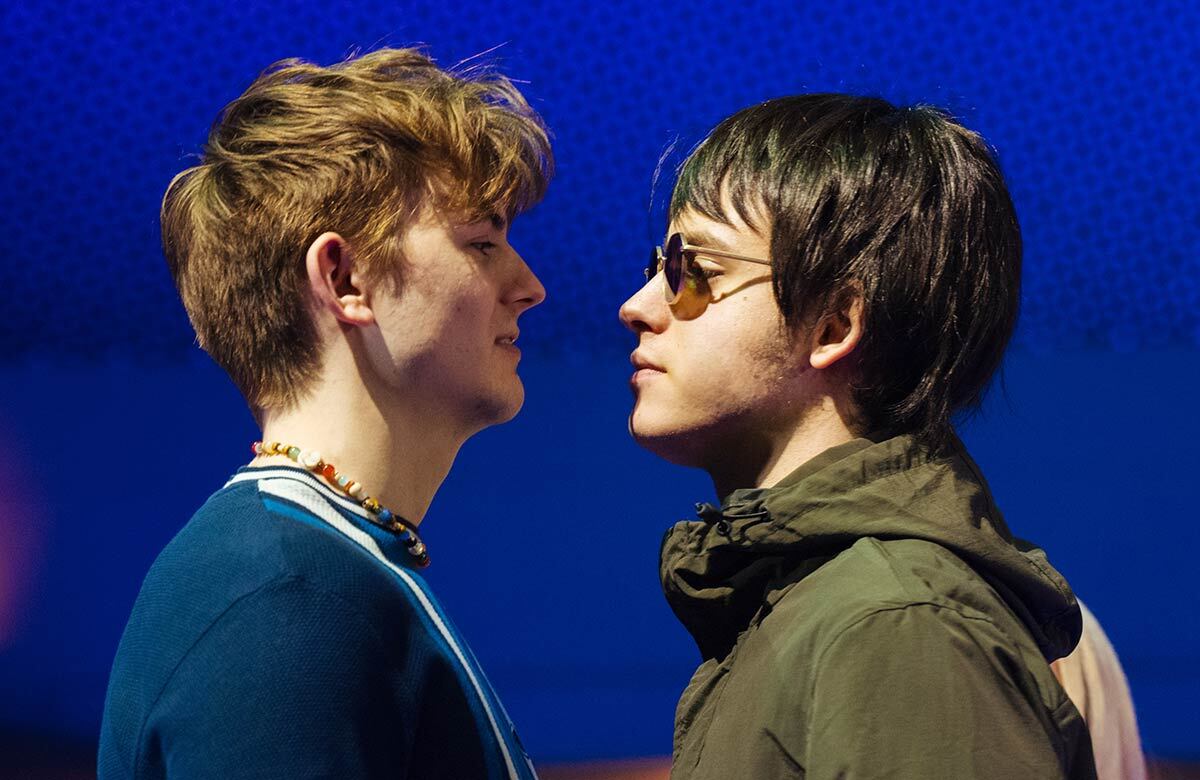
Strong visuals and spiky banter lift this ponderous true story of a clash between Britpop stars


Dramatising the 1995 singles-chart showdown between Blur’s Country House and Oasis’ Roll with It – hyped in the press as “the Battle of Britpop” – this fun but baggy nostalgic comedy is the first play by novelist John Niven. Tracking events from the Brit Awards through to the release of Oasis’ mega-hit album (What’s the Story) Morning Glory?, the script is thoroughly researched, packed with jokes and 1990s pop-culture references.
All this factual information sometimes comes at the expense of dramatic momentum. There are times when the characters rehash their careers and past experiences as though they were competing in a pub-quiz music round. But moment by moment, the dialogue is lively, full of believable bickering and sweary banter.
Director Matthew Dunster works in some playful visuals and striking, anarchic imagery, but between these attention-grabbing high points, the pace flags. For a story that should be bursting with youthful vitality, the cast spends a surprising amount of time seated – in deckchairs, on couches, in a bathtub at one point – sapping the play’s energy.
Continues...
Read More

Sound designer Ian Dickinson lifts proceedings with a soundtrack of era-appropriate Britpop hits delivered in brief, devastatingly loud blurts, which play over video by Tal Rosner. These take in vivid, hyperactive, music-video style clips of rippling colour and texture. And John O’Connor provides animated sequences in a wobbly, Beavis and Butt-Head-esque style, in which assorted radio DJs provide context and running commentary, going some way to cover the production’s laborious scene changes.
Sets by Fly Davis depict the various recording studios, trailers and swanky clubs where the action unfolds by way of moveable flats and sections of modular stage, which are wheeled on and off through a pair of massive gates. Simple as each element is, it all looks dazzling under Jessica Hung Han Yun’s punchy lights, which blaze in tangerine, purple and indigo. Intense blue backlighting creates stark silhouettes during one memorable sequence.
As Blur frontman Damon Albarn, Oscar Lloyd hides fierce ambition and building angst under a facade of disdainful detachment, publicly mocking the concocted rivalry between the groups while stoking it behind the scenes. Positioned as his opposite, Paddy Stafford’s Noel Gallagher is the play’s most fully developed character, driven to succeed by the same unexamined emotional turmoil that makes him and his brother so volatile. And as Liam Gallagher, George Usher is all puff and swagger, bragging and making increasingly violent threats he will come to regret when the play makes a hairpin swerve into surreal, farcical territory in its final scenes.
It’s a bold ending for a piece that never quite gets moving, but which packs in enough humour and nostalgia to satisfy fans of either band.
For all the latest theatre reviews, sign up to The Stage’s weekly reviews newsletter


Most Read
Across The Stage this weekYour subscription helps ensure our journalism can continue
Invest in The Stage today with a subscription starting at just £7.99

© Copyright The Stage Media Company Limited 2026


