


Sweat review


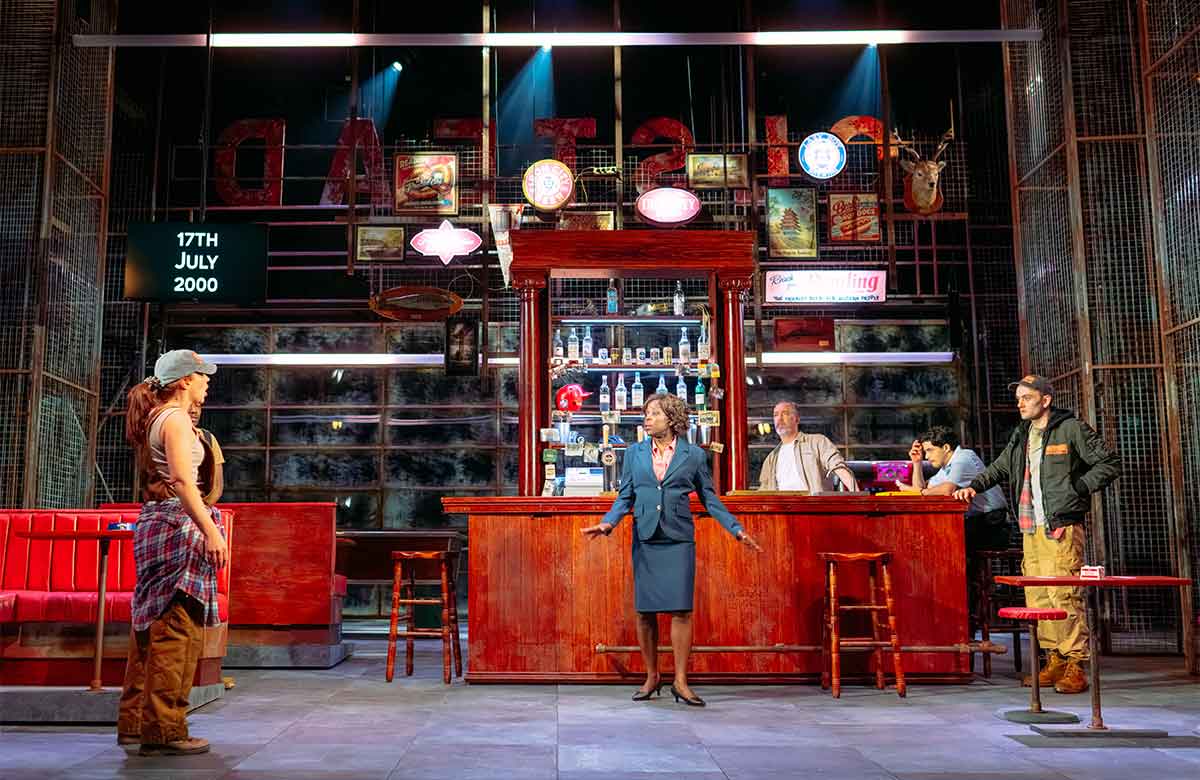
A superbly realised staging of Lynn Nottage’s mighty play


What a mighty play Lynn Nottage’s Sweat is. A Pulitzer prize-winner in 2017, following runs off and on Broadway, it is an indictment of American capitalism, a chronicle of human suffering and a study of fraying social fabric as sturdy and as stirring as anything by Arthur Miller or John Steinbeck.
Audiences in London and Manchester know this already, of course, thanks to celebrated stagings from Lynette Linton and Jade Lewis. Now, it is Glasgow’s turn, while Edinburgh will get a look when this fresh staging swaps the Citizens Theatre for the Royal Lyceum Theatre later this month.
Perhaps, in the not-so-distant future, Sweat will be considered such a classic that reviews can skip the plot summary. This is Scotland’s first encounter with it, though, so here comes one: set in 2000, in the rapidly deindustrialising city of Reading, Pennsylvania, the heart of the Rust Belt, the play follows a group of factory workers as their jobs slip from their grasps. Their fathers and grandfathers spent their lives toiling at the Oldstead steel plant, but now the tide has turned, costs are being cut and the bosses are mean. All the talk is of strikes, scabs and skulduggery. Of course, all this resonates in Glasgow, only yards from the former shipyards of the Clyde.
Continues...
Over two-and-a-half hours of beautifully wrought scenes, set largely in a shabby bar, Nottage traces the fallout from this process. A trio of female friends turn on each other when one gets promoted. A father borrows drug money from his son. Two buddies rage at the Latino barback when he crosses the picket line. Racism rears its head. Dreams are dashed. Relationships are rent. Lives are ruined. And flashforwards to 2008 hint that worse is to come with dark dramatic irony. Here, in deeply detailed drama, is the fractured landscape of contemporary America.
Director Joanna Bowman, a rising star in Scottish theatre, realises all this with assurance, unfolding the action with an astute mix of fluid naturalism and directorial flair. A vivid opening image of three workers buzz-sawing long tubes of red-hot steel gives way to a sterile meeting room, before Francis O’Connor’s barroom set drops in via the Citz’s recently redeveloped fly tower.
If there is one flaw in the staging, it is that the play’s rich seam of ribald humour is not fully mined. Bowman draws superb performances from the eight-strong ensemble, though. Any of them could be picked out for praise. Debbie Korley is transfixingly torn as Cynthia, the Black worker who ascends from factory floor to supervisor’s office. Lucianne McEvoy brilliantly slips from brassy to bitter as her friend Tracey. Laura Cairns’ squeaky, squiffy Jessie makes up the trio.
Manuel Pacific’s American-Columbian barback Oscar’s wide-eyed wariness masks an inner steel. Mark Theodore’s jobless junkie Brucie sags and whines like a deflated balloon. Lewis MacDougall and Rudolphe Mdlongwa have slope-shouldered swagger as best pals Jason and Chris. And Christopher Middleton’s one-legged bartender Stan hobbles around the set with sage joviality, pouring drink after drink as the ground gives way beneath his customers.
For all the latest theatre reviews, sign up to The Stage’s weekly reviews newsletter

Most Read
Across The Stage this weekYour subscription helps ensure our journalism can continue
Invest in The Stage today with a subscription starting at just £7.99


© Copyright The Stage Media Company Limited 2026


