


Can touring theatre fix its broken business model?
 Theo Bosanquet
Theo is a freelance writer and editor. Formerly editor of WhatsOnStage, he has written for a range of publications including the Guardian,
...full bioFaced with shrinking programmes, rising costs and venue closures, who would want to run a touring theatre company? Theatremakers from the sector tell Theo Bosanquet about the solutions they are discovering, the support they need to keep going and why they’re not giving up without a fight


Theo is a freelance writer and editor. Formerly editor of WhatsOnStage, he has written for a range of publications including the Guardian,
...full bioThe touring sector – in the stark words of award-winning producer Michael Harrison, when I spoke to him at the end of last year – is “hurtling towards a crisis”. And his assessment, that a combination of rising costs, logistical challenges and a shortage of skilled workers has created a “perfect storm” for this “vital” area of the industry, is backed up by many others.
Emma Rice, who spoke to The Stage on the subject in 2022, feels the situation has deteriorated since. “I genuinely hate to say this, but I think it’s getting worse,” she says. “It doesn’t feel as though we have recovered any meaningful ground since the pandemic, and the fact that venues and their teams remain under such pressure is evident in terms of morale, energy, staff turnover and sector knowledge.”
This is worrying coming from a figure who has been central to the sector ever since joining Kneehigh Theatre as a performer in the 1990s. She now runs the Emma Rice Company, whose current slate of shows includes Malory Towers and North by Northwest, which are touring the UK and US respectively this year. Rice says one component of the current malaise is the decline of so-called guarantee deals, whereby venues offer touring producers a minimum income in order to mitigate risk. “[These] gave a touring company like mine financial security,” she explains. “However, at ERC, we have now given up trying to get guarantees that come anywhere close to matching our running costs. We are still passionate, still hustling, still surviving and still living our dreams – but it is undoubtedly tough and there are no signs of things easing in the near future.”
She compares the myriad rising costs to the game Whac-A-Mole. “Materials, staffing, transport, accommodation [are increasing] – and all in the face of declining income from venues,” she says. “And at the same time, it feels as though many venues have lost their audiences and are struggling to get them back. We want to be part of a shared mission to help rebuild audiences, but it’s tough for a touring company to have a meaningful impact in this area.”
The squeeze on venues is a significant factor. UK Theatre recently published its second annual Theatre in the UK report, which showed a third of theatre organisations across the UK expect to run at a deficit this year, rising to more than 50% in the subsidised sector. It confirms a paradoxical situation in which demand from audiences is at an all-time high, while the financial picture for the buildings and structures enabling the shows gets bleaker.
Continues...
Related to this article


The report also makes clear that touring is one of the areas most affected by the resultant belt-tightening. Rising costs in areas such as staffing, transport, set building and energy mean organisations have less “headroom” to tour work, so it’s often the first thing to be cut.
“The economics of touring, particularly to smaller towns and cities, have deteriorated sharply,” it says, quoting figures from Arts Council England’s recently published touring review that show nearly three quarters of respondents describing the state of touring as “poor or very poor, while almost four in five say it has become significantly harder in recent years”. Of 571 touring organisations surveyed, more than half recorded losses in 2023.
Matthew Xia has been artistic director of Actors Touring Company since 2018. Speaking to me during a break in rehearsals for the company’s production of Small Island in Leeds, he mentions that he’s recently been reading Theatremaker, a memoir by ATC’s influential founding artistic director John Retallack.
“I’ve never known a world like it [the one Retallack describes], where the touring industry is so supported, not just in the UK but around the world,” he says. “You compare it with where we are now, post-pandemic, when everyone is struggling, everything is so bloody expensive and the arts in general are so drastically underfunded. I can’t imagine anyone wanting to start a touring theatre company at this moment in time.”
‘We are still passionate, still hustling, still surviving – but it is undoubtedly tough and there are no signs of things easing in the near future’ – Emma Rice, artistic director
Xia says that larger venues are increasingly “plugging the gap that touring used to fill” by mounting co-productions such as Small Island – a collaboration between ATC, Leeds Playhouse, Birmingham Rep and Nottingham Playhouse – which in turn are driven by the need to share costs. “It feels like we’re just having to find more novel ways to make work,” he adds.
He compares the situation with mainland Europe, where public arts funding has typically remained robust by comparison to the UK. “I’m making a show next year with the National Swedish Touring Theatre [Riksteatern], which gets the equivalent of £6m each year and tours to 230 regional partners around the country. It’s a stark reminder of what the situation can look like when you have a government that really invests in arts, and touring in particular.”
ATC predominantly makes work for the mid-scale sector, which has been especially hard hit. As far back as 2016, Arts Council England reported on “a perceived dearth of quality touring work for the middle-scale”, in which “many companies reported that the pressure on margins, tightened resources, the financial demands made by hosting venues, and a declining number of venues combine to make touring (even if supported by ACE funding) near unaffordable”.
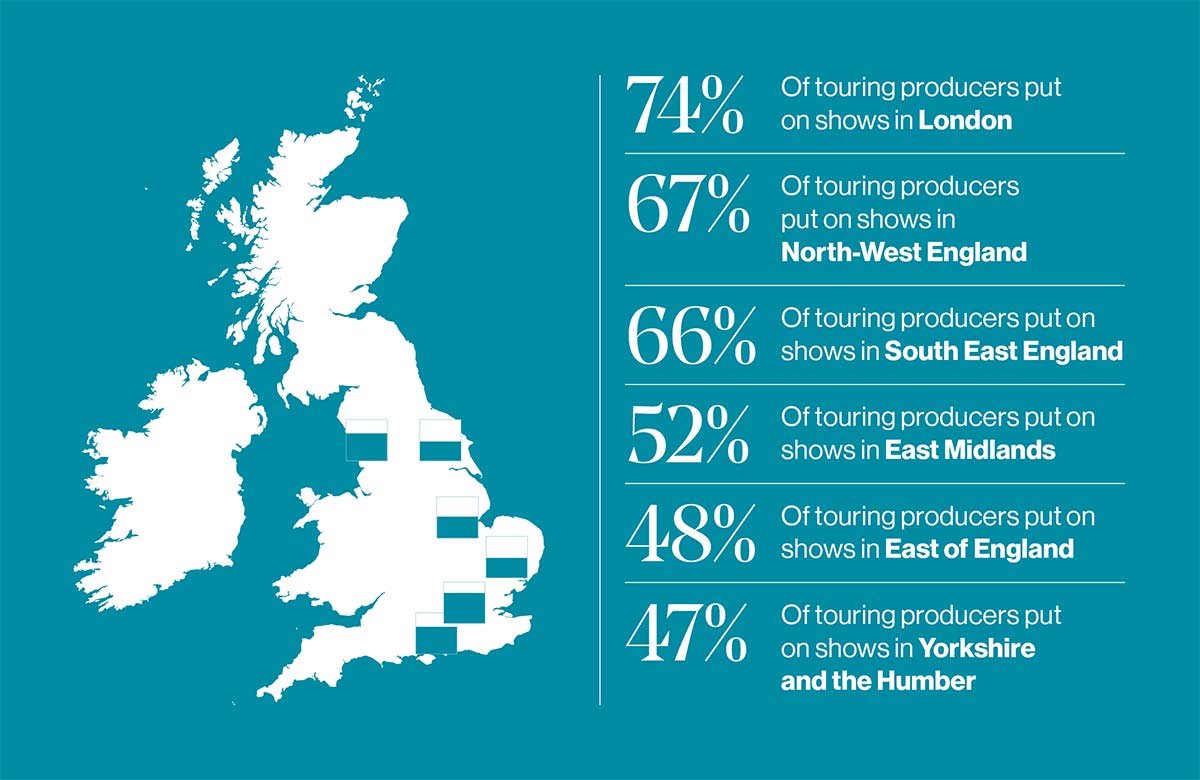
The landscape since then has only grown more challenging and, as a result, communities in smaller towns and more remote areas are most likely to lose out. Data from the recent UK Theatre report confirms this: London is the most frequent touring destination (74%), followed by North West England (67%) and South East England (66%). Touring frequency falls in less densely populated or distant regions: fewer than half tour to the East of England (48%), Yorkshire and the Humber (47%), or the East Midlands (52%). This is evidence, says the report, of “a steady erosion of geographic equity”.
Continues...


Among the regional producing venues, Xia says there has also been an increasing focus on “hyper-local” work which has “crowded out” the work of national touring companies. Then there is the challenge of the post-Covid talent drain and resultant skills shortages. “Lots of people don’t want to tour – we’ve found that time and time again. It’s always been difficult in that regard, but for me it feels more difficult now than at any point in my seven years running this organisation,” Xia says.
The word ‘ecosystem’ is often used to describe the theatre industry, but when it comes to touring, there seems to be a disconnect between success at the larger scale, where big-name shows continue to play in main theatres to capacity audiences, and those at the smaller end, typically producing riskier work in more remote locations.
Adam Knight, chief executive of Blackpool Grand Theatre, agrees it’s a mixed picture. “There are some really big titles out there on the road, particularly in larger metropolitan locations. But I would say that in smaller towns and cities the outlook is not quite as strong, particularly for presenting theatres. The supply of quality, affordable work is a challenge, because of the cost dynamics. Understandably, there’s a risk-averse approach.”
Last month, independent theatre companies Fuel and China Plate linked up with five partner venues across England in a bid to address this, promising to create a series of new touring plays and musicals for the mid-scale.
Knight says that in the past 10 years, there has been a sharp rise in the predominance of one-nighters, acts such as tribute bands, comedians or wrestling shows, which are filling the void created by the dearth of touring productions. “Those [touring shows] are less evident, more sporadic, which means the ability to grow and develop audiences is harder, and it becomes an ever-decreasing circle,” Knight says.
Operating costs have risen, Knight adds, due to factors including rises in the real living wage, to which his venue adheres, as well as employers’ National Insurance increases and wider cost-of-living factors. And there’s a limit to how much these can be mitigated by ticket prices. “In major cities with number-one venues you have a bit more headroom [on prices], but in smaller towns and cities, there’s not so much,” he says.
Continues...

To try to address some of these challenges, last year, Knight helped launch the Local Theatre Touring Alliance. It brings together figures including venue managers, producers, policymakers and other stakeholders in a bid to offer sector-wide support, particularly to mid-scale venues, and avert the widespread closures that are now a growing possibility.
“We’ve made a great start, coming up with an evidence base and a to-do list,” says Knight’s co-founder David Brownlee, “but now we need to make stuff happen. That includes things such as establishing a national touring circuit for drama, starting regional pilots to get venues working more collaboratively and facilitating anti-clash diaries, which used to exist but have largely disappeared.”
Brownlee knows the sector well, having worked for ACE as both a regional and national director. He’s also been executive director of UK Theatre, managing director of data company Purple Seven, and currently runs his own consultancy Data Culture Change. Last year, he authored a report tracking the performing arts market’s post-pandemic recovery, which showed that while ticket sales and capacities have risen in recent years, real-terms revenues and prices are down, with these trends varying markedly based on capacity – larger venues have seen far stronger returns than those lower down the scale.
Brownlee says that one factor behind this is that ACE itself has undergone cuts, and part of the drive behind the creation of the LTTA is to try to replace some of the small and mid-scale sector support that has been lost. “The Arts Council previously had lots more staff and lots more focus on touring, but much of that has gone. So we need to look at what more we can do to support venues and touring companies to work more smartly together,” Brownlee says.
In acknowledgement of this work, ACE recently announced it will be investing in the LTTA as part of its new strategy for touring, which is being spearheaded by Hannah Lake, who has the apt job title of director of touring transformation. Shortly after taking the role in 2024, she introduced the Incentivising Touring Scheme, a repayable grant initiative aiming to reduce the financial risk of larger-scale tours (to venues with more than 500 seats) deemed “too risky in the current financial context”.
The scheme, which is still at the pilot stage, has part-funded more than 15 tours including Regent’s Park Open Air Theatre’s Fiddler on the Roof and Emma Rice Company’s aforementioned Malory Towers. But, as Lake acknowledges, more support is needed. “We know that touring is vital, both to our cultural ecology and to audiences across the country,” she says. “It brings exceptional art and culture to towns, villages and cities everywhere, delivers real economic benefit to local areas and plays a key role in developing the next generation of artists. But rising costs and a difficult funding environment have hit the sector hard.”
ACE’s recent The State of Touring report explored these challenges in detail, concluding that although touring is in “crisis” it is “not entirely broken”. It has led to the creation of ACE’s new Touring Service, which Lake says, “will deliver a simpler, more streamlined and more efficient system for funding touring activity, meaning our investment can go further. It will allow us to serve the sector better, giving organisations the confidence they need to innovate, collaborate and continue to bring brilliant work to communities across the country”.
‘Touring is vital, both to our cultural ecology and to audiences across the country. It plays a key role in developing the next generation of artists’ – Hannah Lake, director of touring transformation, ACE
But will this be enough to rescue a sector that, in the ominous words of Xia, is in danger of “disappearing completely”? Costs are unlikely to come down in the foreseeable future, particularly as energy and fuel prices spike in the wake of the Iran conflict, and more radical interventions may be required as a result.
Independent producer Laura Elmes, whose company Wildpark Entertainment has produced tours including the musical Unfortunate: The Untold Story of Ursula the Sea Witch and improvised show Murder, She Didn’t Write, says ACE should look at broadening its support. “I’d love to see [the ITS] expanded to more shows on the mid-scale,” she says. “Additionally, at the moment, if a show recoups and goes into profit, ACE doesn’t share in that overage. I think they absolutely should, in the same way the other investors in a show do, and that money can go back into the pot to fund more projects. It could eventually be self-sustaining and would be truly game-changing for the touring sector.”
Brownlee echoes these ideas. “[ACE] has done a brilliant job of looking at new financial instruments for large-scale touring, and if it can increase the pot of funds available by recycling those profits to those further down in terms of scale, that would be great.”
He also mentions Theatre Tax Relief, currently 45% for touring productions, as a game-changing initiative, but wonders if it could go further “to support venues that are really honing the skills of the profession”. This is something LTTA is lobbying for, in collaboration with small-scale music venues. As he puts it, “a comparatively tiny amount from the Treasury could make a huge difference”.
Exposure to theatre is a key in cultivating future workers as well as audiences, and Elmes highlights the importance of touring in this regard. “I know, for me, an annual visit to the Mayflower Theatre in Southampton is the very reason I work in theatre today, and you hear similar stories from almost everyone in our industry. Without their local theatre, there are so many incredible actors, crew, creatives and behind-the-scenes workers who may never have entered our industry, and some of the biggest hits may never have been made.”
The touring tradition goes as far back as the roots of drama itself, and its standard-bearers include Shakespeare, who took plays around the country with his company the King’s Men. It’s no exaggeration to say that without the touring model, many of the writers and works we consider canonical today would never have achieved their lasting fame. The sector’s survival is of pressing importance to the entire theatre ecology.
As Rice puts it: “I fear that touring is now a broken business model, and I can’t see how companies like mine will be able to carry on doing it if things don’t change. But things have to change and must change. This touring way of life is precious, important, radical and progressive. I will advocate for it, celebrate and dream of it always. I’m not giving up without a fight.”



Long Reads






Recommended for you
Opinion




Most Read
Across The Stage this weekYour subscription helps ensure our journalism can continue
Invest in The Stage today with a subscription starting at just £7.99

© Copyright The Stage Media Company Limited 2026


