


Bird Grove review


Alexi Kaye Campbell’s new drama about George Eliot is nicely crafted and vibrantly performed


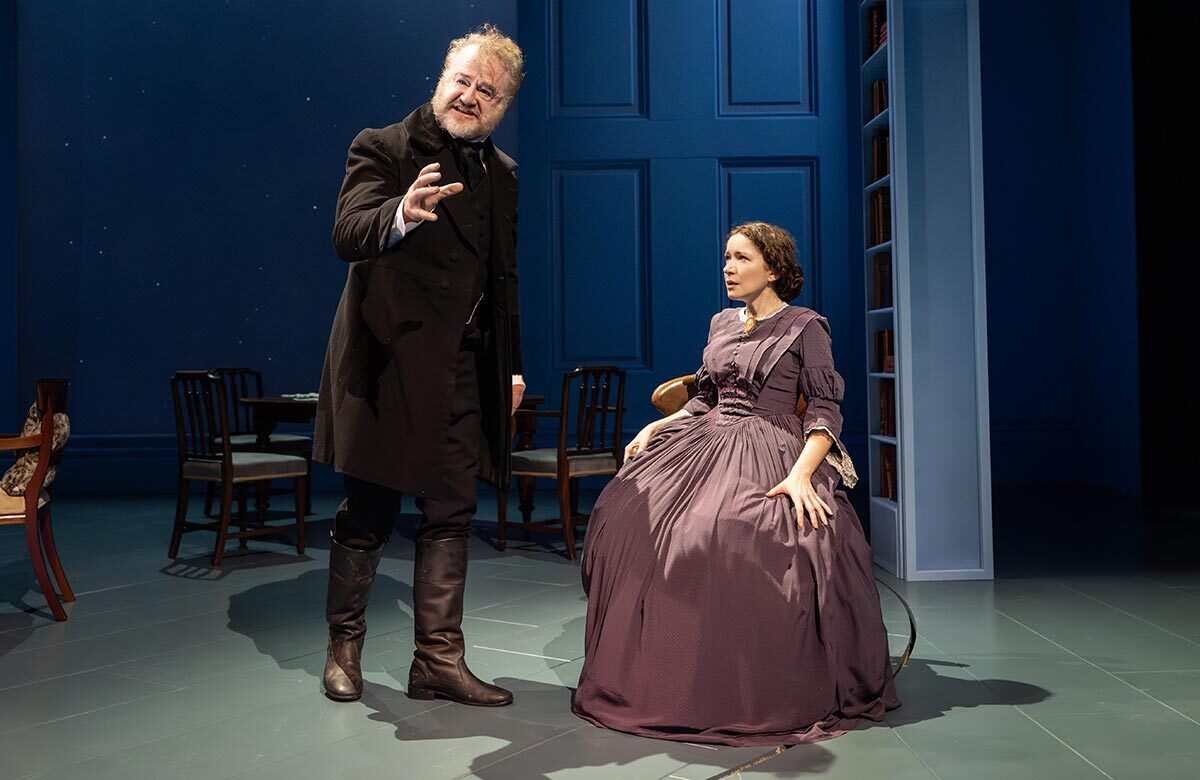
George Eliot’s Middlemarch is often cited as an exemplar of the English novel. So it’s apt that this new play by Alexi Kaye Campbell should be so elegantly written. It finds Mary Ann Evans – the woman behind the famous pen name – on the cusp of discovering her calling, and Bird Grove has the sharp eye for social hierarchy of Eliot herself, as well as the high colour and melodramatic dash of Dickens. There’s also a faint Chekhovian flavour to its final, wistful scenes, in which a large house becomes the repository of memory and lives left behind. In an uncluttered, engaging production by Anna Ledwich, it’s a period drama with a modern sensibility, witty and tinged with irony. It’s decorous: handsomely dressed, a little too static, a little too verbose. But it is never stuffy.
It’s 1841, and Mary Ann (Elizabeth Dulau) lives with her father, former estate manager Robert (Owen Teale), at Bird Grove, an impressive home in Coventry. Robert and his starchy son Isaac (Jolyon Coy) hope that Mary Ann will agree to marry – although Robert, who has given his daughter a good education and recognises her exceptional sensibility, is reluctant to pressure her into accepting any prospective husband who’s unworthy of her. Mary Ann, meanwhile, has forged a socially risky allegiance with progressive local couple the Brays and, while she adores her dad and is adept at maintaining domestic harmony, is hankering to express the myriad ideas that crowd her brilliant mind. A burgeoning frustration with patriarchal power structures and a reassessment of Christianity bring her into cataclysmic conflict with convention and with her beloved father; but the crisis also sparks the creativity that will make her literary male pseudonym echo down the ages.
Continues...
Read More
Campbell takes longer than necessary to trace that trajectory and there’s some dialogue about who gets to tell the stories that shape our world that seems slightly stale. But Ledwich’s production is lively and vibrantly performed, on a turquoise set by Sarah Beaton that gracefully suggests airy rooms and high ceilings, and makes discreet use of a revolve. Dulau is a forthright, confident, zingily intelligent Mary Ann, and the tenderness between her and Teale’s wryly funny, pragmatic, self-made man Robert feels touchingly authentic. Rebecca Scroggs is wise and wary as Mary Ann’s friend and confidante Cara Bray, and Sarah Woodward movingly maternal and entertainingly eccentric as her teacher from childhood, Maria. Jonnie Broadbent serves up a ripe, very funny cameo as Mary Ann’s inept and mercenary suitor, hilariously hampered by his bumptiousness and by volcanic gastric trouble.
Overall, this is a well-crafted play that carries us efficiently to our inevitable destination, its placid surface rippled by rising passions. If it’s just a touch overstretched and undernourished, it is also, on the whole, very nicely done.
For all the latest theatre reviews, sign up to The Stage’s weekly reviews newsletter

Most Read
Across The Stage this weekYour subscription helps ensure our journalism can continue
Invest in The Stage today with a subscription starting at just £7.99


© Copyright The Stage Media Company Limited 2026


