


Animal Farm review


Cohesive ensemble work contrasts with a disconnect between Orwell’s text and the characters delivering it


It is well known that George Orwell’s satirical allegory was based on events leading up to and during the regime of Stalin, and was coloured by his own experiences of the Spanish Civil War. While being inspired by historical events, Orwell’s forensic examination of the Soviet revolution rises above the history books. It is for all time, emphatically and uncompromisingly of the here and now.
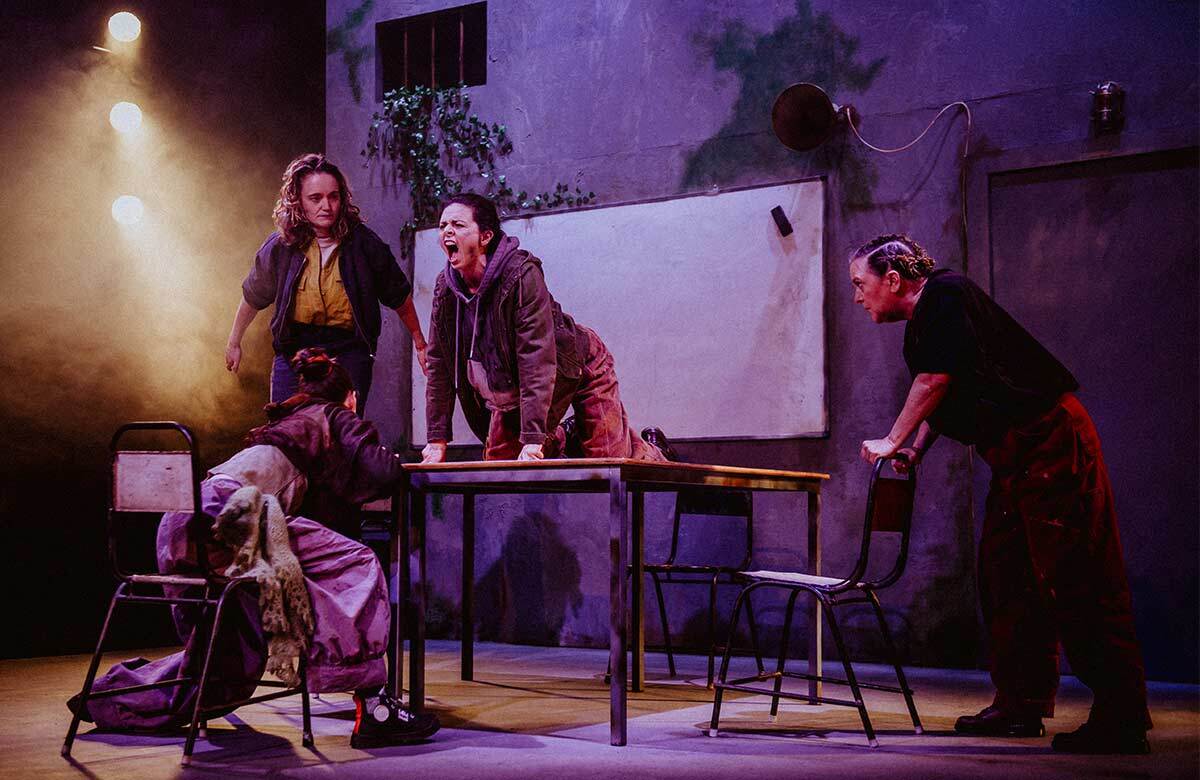
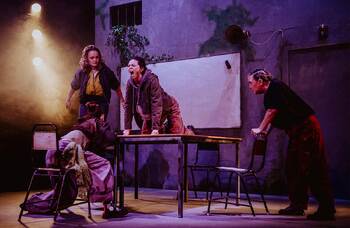
Tinderbox artistic director Patrick J O’Reilly pours his theatrical imagination and his Le Coq background into a radical adaptation, delivered, not through a narrative-driven dramatisation, but via the text of the book itself. As high-profile authoritarian leaders flex their muscles, ranting and railing against disputed legal and political decisions, here we are confronted by the prospect of a parallel universe of contemporary currency. With street protests raging across the world, O’Reilly introduces four anonymous female protesters, who, for reasons unknown, are detained in an interrogation centre. Each identifies as George Orwell before launching into the text of Animal Farm, a book barred by the authorities. From the off, these verbatim readings constitute an abrupt transition from stage to page.
Continues...
Related to this Review
Through an uneasy balance of animal and human characterisations, the familiar storyline unspools briskly. Echoing Bolshevik revolutionaries, a group of rebellious animals overthrow the owner of their home farm and establish it as a cooperative, with its own dangerously flexible rules. They clearly set out their idealistic aspirations: equal status, working for the common good and the rejection of any form of human intervention in their enterprise. Time passes and the lines between human nature and animal instincts slowly blur, prompting the pigs to modify their rules as they indulge in shameless corruption and embark upon an ugly, internecine power struggle.
The four actors combine effectively as an ensemble, with Jo Donnelly leading the charge as the thuggish boar Napoleon, hell-bent on upending the status quo and taking charge. He is supported by a parade of anthropomorphic creatures: Catriona McFeely’s canny, scheming porker Snowball and wise mare Clover; Clare McMahon’s flighty filly Mollie and valiant old workhorse Boxer; Susan Hoffman’s sycophantic Squealer, Napoleon’s sidekick; plus a gaggle of dim-witted hens and sheep.
Tracey Lindsay’s grim, faceless cell is equipped with CCTV, a tannoy speaker, infrared lighting and a mural embellished with ferns and ivy. Does this green flourish hint that the women may be environmental protesters? Who knows? There are several vital elements in this blend of ensemble theatre and scripted readings that require contextual explanation and clarification. While the cast’s collective physical theatre skills are to be applauded, the use of the book as an unnamed political manifesto feels disconnected from the drama, causing a degree of hesitation with lines and an unexpected drop in tension during the second act’s high-octane riot scenes.
For all the latest theatre reviews, sign up to The Stage’s weekly reviews newsletter

More Reviews
More Reviews
Recommended for you
Most Read
Across The Stage this weekYour subscription helps ensure our journalism can continue
Invest in The Stage today with a subscription starting at just £7.99

© Copyright The Stage Media Company Limited 2026


