ao link

Bryony Kimmings

“Theatre is not a game for people who need to pay the mortgage”
Bryony Kimmings
Bryony Kimmings

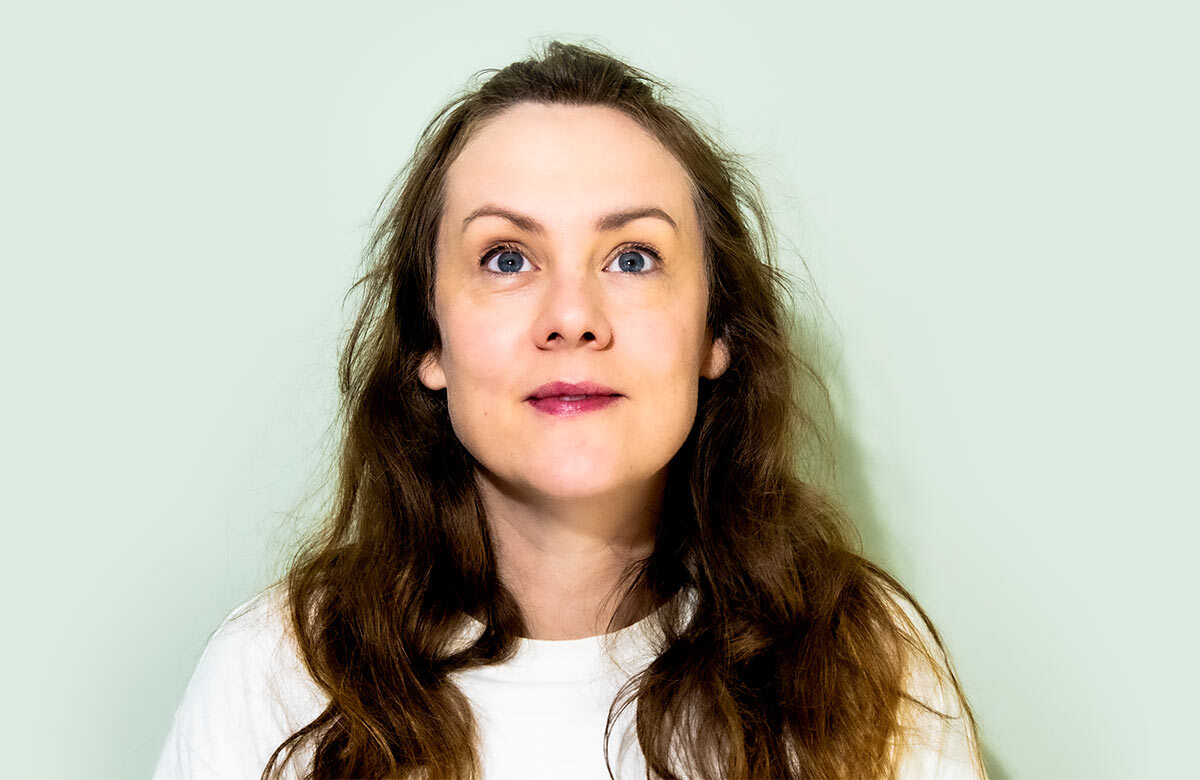
In her return to the stage after five years, Bryony Kimmings is using her comedic and highly participatory style of storytelling to tackle climate anxiety head-on. She speaks to Lyn Gardner about her love-hate relationship with theatre, moving to the countryside and how her new show at Soho Theatre Walthamstow is pared-back and highly personal

FacebookTwitterLinkedIn

When Bryony Kimmings finished performing her last show, I’m a Phoenix, Bitch, in 2020, just before the pandemic lockdowns, she felt she was also finished with theatre. “I thought: ‘Nah, I’m done with that,’” says Kimmings. Phoenix, a dark fairytale about postnatal life and a true story of depression, relationship breakdown and serious illness, had taken its toll on her. “I was really burned out.”

She was also increasingly in demand as a screenwriter for TV and film. She co-wrote the 2019 movie Last Christmas with Emma Thompson and the upcoming TV series The Rapture, based on Liz Jensen’s novel. “Why would I want to keep reducing my income and not be able to see my child or take him to school to do theatre? Particularly when it can be so toxic and it requires antisocial hours and so much travel. Theatre is not a game for people who have kids and need to pay the mortgage. That’s sad, but true.”

But this month, five years since she last presented a theatre show, Kimmings will be back on stage for a run of her latest piece, Bog Witch, at Soho Theatre’s much-heralded new Walthamstow venue. The story of a year in her life over four seasons, and about being possibly the world’s most unlikely eco-convert, it tells of the move that she and her partner Will and kids made to the country in 2022 – an intentional step towards a sustainable, ecologically sound way of life.

“It was my last attempt to get happy and release myself from the grip of something that felt unsustainable and bad for me. There’s a line in the show when I say: ‘I’ve got a massive hole – not that one down there, although that is absolutely massive – it’s in my soul.’ Everyone has a yearning feeling, and we fill it up with superfluous things. I was always buying things and just never sitting with this deeper feeling. So, it’s a classic Bryony show. It starts light and then smacks you in the face and makes you cry.”

Confronting climate anxiety

The move to the country was no picnic for Kimmings. The previous time she tried country living, her baby son got very sick and she “had a breakdown” – life experiences chronicled in I’m a Phoenix, Bitch. “This time, I arrived in this silent, green, spider-infested landscape and went: ‘What was I thinking of?’ But the kids loved it, Will loved it. I had found out during the pandemic that I had ADHD, which explained a lot about why I was constantly performing, because it gave me a dopamine high. So, when I hated the country, I could be kind to myself and say: ‘No wonder you hate it – you’ve spent your whole life filling that hole with excitement.’”

Gradually, she learned to love the quiet, the mud and the trees changing with the seasons. “When you remove your crutches, amazing things happen.” She started to take an interest in what Will was doing in the garden, and swapped her murder podcasts (“which would keep me in an anxious state, feeding the dopamine beast”) for ones about the environment and ecology.

Continues...


Related to this article

A Pacifist's Guide to the War on CancerA Pacifist's Guide to the War on Cancer
Bog Witch reviewBog Witch review
Coronavirus: Bryony Kimmings and Brian Lobel artist support initiative raised £30,000 in MarchCoronavirus: Bryony Kimmings and Brian Lobel artist support initiative raised £30,000 in March
I'm a Phoenix, BitchI'm a Phoenix, Bitch
Soho Theatre Walthamstow: first look at London’s newest venueSoho Theatre Walthamstow: first look at London’s newest venue

Not that it was necessarily an obvious swap. “Don’t give anxious people material about the climate because they will literally lose it. And I did. I thought I had set myself mad again. My anxiety found a new thing to attach itself to. But not as badly as before. I have arguments with my therapist where I say that it’s not anxiety, because anxiety is a fear of catastrophe in the future that is unfounded, and climate anxiety is not about something unfounded. So, I started to look into climate anxiety, and when Soho approached me about a commission, I knew that was what the show had to be about.” Initially, the show was called Soil and Water. “But who’d buy a ticket to see that? No one.”

Bog Witch is a comedy about climate change that isn’t designed to make audiences feel bad or angry or leave them feeling helpless and unable to face the inconvenient truth of what is happening to the planet.

“I had to find a place where I could live with what I know about the climate without being overwhelmed by it, so you can look and think hard about what’s happening rather than feeling you can’t face it. I thought: ‘What am I good at? I’m good at telling stories and talking about the things that are taboo.’ So, I’m telling a story – a story not about dystopian hellscapes or how to tackle the whole problem, but the things we can all do, the things that made me feel better about it and not turn my head away.”

‘Humans are inherently brilliant. Maybe we can be excited and glad that we are alive at a time when we can pull back on the planetary crisis’

Kimmings is an optimist about human beings and the radical potential of theatre. “Humans are inherently brilliant. Maybe we can be excited and glad that we are alive at a time when we can pull back on the planetary crisis. There is a lot of audience participation in this show. What I love about theatre is that you can have 1,000 people connecting in a room. It’s like nothing else.” In previous shows, Kimmings has proved herself a mistress of audience participation, navigating the line between manipulation and so taking care of an audience that they feel safe enough to be as open and honest and sharing as she has been.

“Theatre is a marvellous, seductive tool that doesn’t exist in any other medium. You can write lots of stories for telly, but it’s not the same. It’s only in theatre that I can stand on a stage and speak directly from my own experience. There is no space anywhere else for that, and I realised I missed that element of my practice.”

A love-hate relationship

But she has a love-hate relationship with theatre and the way the industry treats its artists, mostly freelancers. Back in the glory days of Twitter (long before it became X), she started a campaign called I’ll Show You Mine, encouraging artists to share information about venue deals for touring shows on the basis that knowledge is power and sharing your deal, rather than keeping it close to your chest, was a way to create greater equality across the sector for all artists at all stages of their careers. During the pandemic, together with artist Brian Lobel, she started #GigAid to help support artists facing hardship.

“We had to put our money where our mouth was. We could see that nobody was going to look after the artists, so we had to look after them ourselves and hope others would follow by example.” The fund distributed £30,000 in the first month of the pandemic.

She is scathing about theatre’s post-Covid retrenchments wiping away the advances that were happening. “The gates felt as if they were opening before the pandemic. We were having conversations about how to care more about artists, how to fund childcare for artists, support parents and others. That’s all been flattened, things have gone back.” She cites an example of talking to someone recently who had been in a rehearsal room with a male director behaving badly.

 “I asked: ‘Why didn’t you leave?’ and they said they couldn’t afford to leave. People don’t speak out because they don’t want to burn their careers to the ground. They don’t want to be seen as a problem, so they assimilate to protect themselves.”

‘People don’t speak out because they don’t want to burn their careers to the ground’

My first experience of a Kimmings show was Sex Idiot at the Edinburgh Fringe in 2010. Discovering she had contracted an STD, she got in contact with her ex-sexual partners. From these interactions she created a funny, moving piece about both her genitals and the state of her heart, which involved the most unlikely piece of audience participation: she asked us to contribute a few strands of our pubic hair, out of which she fashioned a moustache in front of us on stage. Our level of engagement was such that most of us actually obliged.

Since then, Kimmings has made a string of memorable shows, including 2011’s 7 Day Drunk, exploring the romantic myth of the drunken artist whose creativity is fuelled by alcohol (“I have a problematic relationship with alcohol and am currently sober,” says Kimmings), and Credible Likeable Superstar Role Model (2013), made with her then-nine-year-old niece, Taylor, in protest against the hypersexualisation of tweenage girls. Then, in 2015’s Fake It ‘Til You Make It, she teamed up with her then-partner Tim Grayburn (who is the father of her son) to talk openly and honestly about male mental health and loving a man with depression.

Continues...

Bryony Kimmings in rehearsal for Bog Witch at Soho Theatre Walthamstow
Hal Fowler (centre) and the cast of A Pacifist's Guide to the War on Cancer at the National Theatre, London (2016). Photo: Mark Douet

At the National Theatre in 2016, A Pacifist’s Guide to the War on Cancer, co-created with Lobel and Tom Parkinson, featured dancing tumours and songs and made a virtue out of the utter ridiculousness of making a musical out of cancer. It was so disarming that the quiet sound of sobbing could be heard during the latter stages all around the auditorium.

The shows have been getting ever bigger, but in the spirit of removing excess from her life and discarding what is not needed, she describes Bog Witch as “very lo-fi, analogue; a very pared-back, almost Brechtian space. Much more stand-uppy than my previous shows. There are lots of objects that are repurposed. I was thinking about people buying a ticket for the theatre and how they could be thinking about buying a ticket to see Stranger Things or a ticket to see Bog Witch. I can’t compete with Stranger Things and that style of theatre. And I don’t want to. What I want to do is go back to basics: to the words, a few objects. Give me a stick, a drum and a backpack of objects and I can tell you a story and make it fantastical from these small things.”

Life on stage

I have heard Kimmings described as the godmother of confessional theatre. She pushes back against such descriptions, pointing out that her work, which has its roots in live art as much as theatre, comes in a long lineage of female performers such as Ursula Martinez, Stacy Makishi and Penny Arcade. In turn, the success of her shows has inspired a generation of artists to make autobiographical theatre. “I teach courses on autobiographical theatre, so maybe people think I am cashing in.”

But she is firm that what she does and what she encourages other artists to make is not just confessional. “My favourite type of theatre is when I see people being themselves and telling me about something I haven’t thought about before about the world and what we might do about it. I am so aware that when an audience arrives to see one of my shows, they are probably thinking: ‘I wish I’d gone for a pizza instead.’ So, [the work] is very purposefully designed and craftily crafted. It is a real art, not just confession.”

‘How does telling this story about myself, which alone would just be a narcissistic exercise, help other people in their lives or make them feel seen?’

She adds: “For me, the question is always: how does telling this story about myself, which alone would just be a narcissistic exercise, help other people in their lives or make them feel seen? How can I ensure that the work is always kind, generous and hand-holding.”

Not that people are always kind back. When, in 2016, her baby son got very ill, someone wrote on Kimmings’ Facebook page: “Well, at least it will make a good show.”

“I was like: ‘Oh, my God. What am I? Who am I? What do people think I am?’ It wasn’t just shocking because it was really mean – because it was really mean – but because it shocked me into thinking hard about my practice and my career. I hadn’t really experienced tragedy before, and the last thing I was thinking about was making a show about my son’s illness.”

Continues...


Q&A: Bryony Kimmings

What was your first job?
I worked in a fish and chip shop when I was 15. My first paid theatre job was a show my friend Alex and I put on together called Stick It in My Party Hole. It was like The Mighty Boosh, but rubbish.

What is your next job? 
An eco-horror film called Little Red Hen about systemic collapse, generational beef and one night of mania on an eco homestead. Funny and gory.

What do you wish someone had told you when you were starting out?
I wish I hadn’t been obsessed with making sure I had contacts in my diary. I thought you needed them to be an artist. I wish someone had said that what you need to do is make bits of work and show them to people over and over again until you understand the relationship between yourself and the audience and figure out what you want to say.

Who or what is your biggest influence?
I guess it’s logical that this would be quite far-reaching. Forced Entertainment, the films of John Waters, the 1980s movie Labyrinth, Greek myths, witchcraft, Alan Menken, Annie Sprinkle, and trash TV like Married at First Sight.

What is your best piece of advice for auditions?
Be yourself. Actors are ten a penny. Personality, genuine kindness and ravenous intellect are far less common.

If you hadn’t been a theatremaker, what would you have been?
A lawyer. Specifically a criminal law barrister.

Do you have any theatrical superstitions or rituals?
I warm up on stage while the theatre is quiet to remember that it’s just a room. I go into my dressing room, do make-up and costume, then spend half an hour doing visualisations and positive affirmations to calm myself. Before I go on, I close my eyes and say goodnight to my son in my head. I am not me on stage, I am stage me; I have learned it’s important to know the difference. It’s also important to have a post-show moment to shake the show off, collect oneself, transform back into myself.

Tim Grayburn and Bryony Kimmings  in Fake It ‘Til You Make It (2015)
Tim Grayburn and Bryony Kimmings in Fake It ‘Til You Make It (2015)

It was a bad time: her relationship with Grayburn was breaking down and she had postnatal depression. “We had made a show together, and Fake It ‘Til You Make It had so many positives, we had so many emails from people saying, ‘Thank you for telling this story.’ But when the shit really hit the fan and our son got sick, we found that we didn’t really know each other, so we couldn’t help each other.” Looking back, she says: “I would now ask myself why I thought it was appropriate to make Fake It with Tim. My intentions were good. I was really in love and I didn’t want him to be depressed and I didn’t want him to die, and I thought that getting him away from his job and getting him to make a show with me was the answer.”

It is why, when she decided to make Bog Witch, she made a pact with her current partner – with whom she says she can talk about “the knotty stuff” – about what would and would not go in the show. Also, her experience of making I’m a Phoenix, Bitch had been so traumatising that she went back into therapy, and when the show got a second run, she embedded CBT into it to help her cope.

Around that time, she had a conversation with artist Scottee. “He was talking about how trauma is our currency [as working-class artists] because we don’t have power, we don’t have the money to buy ourselves time to make, and we can’t work for free. I said: ‘Scottee, you are really hitting me.’ And thinking about that was another of the reasons why I didn’t make theatre for so long.”

‘I think feeling scared is a good thing, because it’s a sign of just how much I’ve changed, how far I’ve come’

So, before accepting the commission for Bog Witch, she and Will talked a lot about what would and could not be in the show. “There is still some really intensely personal stuff, including a lost baby, but I’ve had the conversations with him, and myself, which I hadn’t had in previous shows, about why you would tell about certain things like the baby. What’s the point of it? How will it make you feel to tell that every day in a way that relates to the audience? How is the loss of a baby going to allow us to talk about loss and maybe the loss of the planet? Why are you crafting this personal story in this way and exposing yourself in this way?” She continues: “It’s just a much more grown-up process. I’ve had much more therapy, I’m in a relationship where I can say anything to my partner, and I’m older.”

Not that performing after all this time isn’t a scary proposition. Kimmings has been making the show over several months rather than in one chunk, and when, at Latitude this summer, she performed a small bit as a work in progress, she discovered that she was terrified to be in front of an audience after such a long hiatus.

“For a long time, I’ve just been sitting in a tiny room writing by myself, and suddenly performing to all these people was overwhelming. I was so scared, and I can’t remember ever having any fear before about going on stage. Then I thought I was constantly performing since I was 20. Not a month went by that I wasn’t on stage, and then five years have gone by, and I look back and go: ‘Who the hell was that person? How did she ever cope with that?’ But I think feeling scared is a good thing, because it’s a sign of just how much I’ve changed, how far I’ve come.”


Bog Witch runs at Soho Theatre Walthamstow, London from October 9-25

Big Interviews

Lynette Linton
“Tell the truth of the work and get the right people in the room”

Lynette Linton

Michael Sheen
“It’s not charity work. I’m not doing this as some sort of Welsh saviour”

Michael Sheen

Annilese Miskimmon
“Without ENO, UK opera would be denuded of ambition and excitement”

Annilese Miskimmon

Adele Thomas and Sarah Crabtree
“We’ve wondered whether we should go dark for a period of time”

Adele Thomas and Sarah Crabtree

Nikolai Foster
“Being an artistic director forces you to grow up quickly”

Nikolai Foster

Elizabeth McGovern
“Doing theatre meant I could hold my own on Downton Abbey”

Elizabeth McGovern

Sutton Foster
“I know who I am, what I stand for and I look forward to bringing theatre back”

Sutton Foster

Carrie Hope Fletcher
“If our industry is worthless, turn off Netflix”

Carrie Hope Fletcher

Julian Bird
“Our place in the world is at risk. It’s as grave as that”

Julian Bird

Nancy Carroll
“As long as my body serves me, I want to use it. It’s my tool bag”

Nancy Carroll

Your subscription helps ensure our journalism can continue

Invest in The Stage today with a subscription starting at just £7.99

The Stage

© Copyright The Stage Media Company Limited 2026

Facebook
Instagram
X
Linked In
Pinterest
YouTube