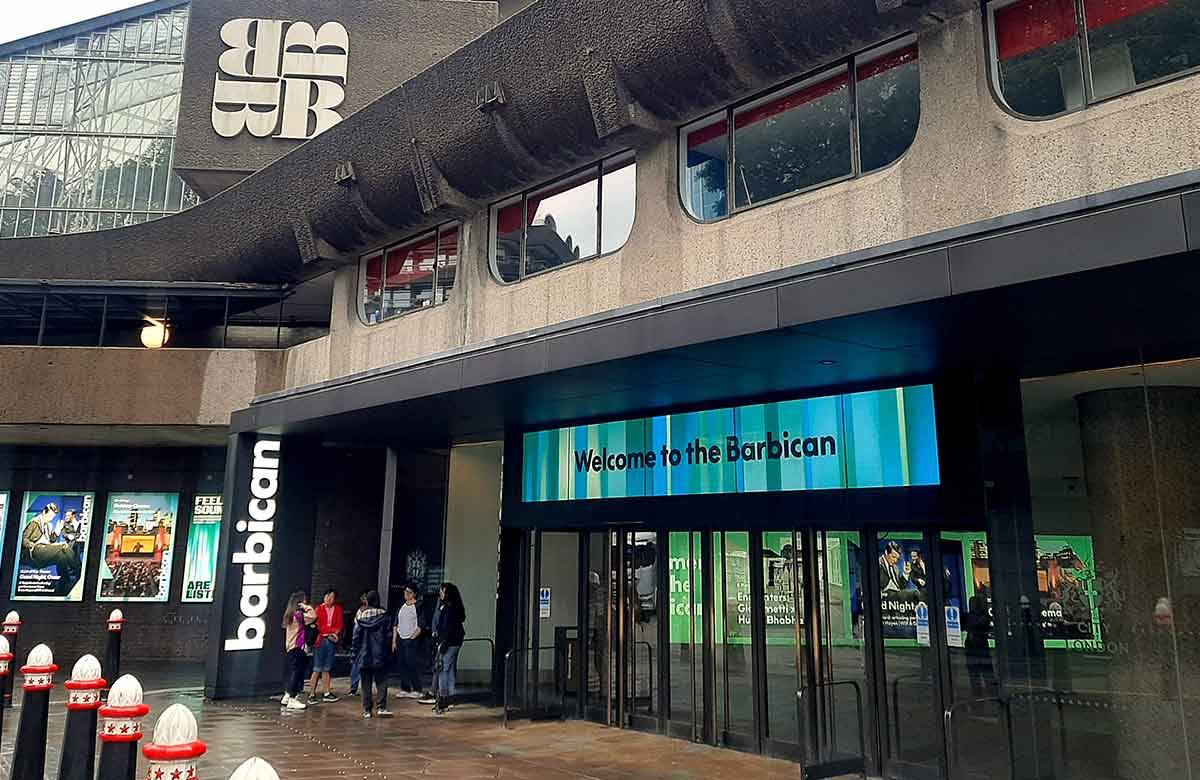
Like a doomed love affair, the Barbican’s relationship with its current artistic lead has been short-lived. Less than two years after appointing Devyani Saltzman as director for arts and participation – for all intents and purposes, its artistic director – she has been made redundant and will leave in May, as we exclusively reported earlier this week.
Saltzman took up the position in June 2024, replacing Will Gompertz, who had the more blatant title of artistic director. Perhaps by tweaking the title the Barbican didn’t think we’d notice it so much if and when it decided it no longer needed someone in the post. That time, it seems, is now.
The Barbican indicated in an update on its website this week that the arts centre will not be looking to replace the role. Instead, it seems chief executive Abigail Pogson, who took up the post in January, will have sole responsibility for running the venue.
Continues...
A spokesperson for the venue told me that the heads of art forms will "continue to lead and drive forward our programming", including Toni Racklin as head of theatre and dance. Let’s be clear, Racklin does a fine job. But the optics of getting rid of your artistic director, particularly during a time of flux (the venue is preparing to close for a year to carry out upgrades) and against a wider backdrop of uncertainty and general anxiety in the sector, aren’t very good.
There was a time when the model of an artistic director (responsible for overseeing the creative output of an organisation) worked hand-in-hand with a chief executive or executive director, responsible for more of the financial, business side of things. Some of the most successfully run venues in the country operate with this model. I’m thinking of Curve in Leicester, where the relationship between chief executive Chris Stafford and artistic director Nikolai Foster is responsible for a hugely satisfying operation, both for audiences and the theatre itself.
Slowly, though, this model has been eroded in recent years, with more of a shift to chief executives taking over the sole running of venues.
And it doesn’t always work. Lessons should be learned, for example, from the recent case of the Royal Exchange in Manchester. Back in 2023, the venue abandoned its artistic director model for the first time in its 47-year history, and instead, appointed a creative director who, it said, would work as part of a trio of artistic leaders. Selina Cartmell was appointed to the role, with then-chief executive Stephen Freeman ultimately running the venue.
However, the Royal Exchange’s restructure didn’t serve it well when, in 2025, it found itself at the heart of a censorship row over a production of A Midsummer Night’s Dream. An independent review into the last-minute cancellation of the play pointed towards “significant systemic organisational and leadership failures” at the venue. The review concluded that “failure to maintain robust support during a period of leadership change, led to multiple issues on A Midsummer Night’s Dream and its ultimate cancellation”. It argued that there was a need to make sure “the theatre’s artistic leader is fully empowered and properly resourced to reinstate the theatre’s distinctive artistic voice and is supported by a well-defined producing pathway and team with clear reporting lines to the senior leadership”.
Had an artistic director been present at the time, it’s arguable the situation would not have unfolded as it did. The Royal Exchange has, interestingly, now returned to an artistic director model, with Cartmell in the role of artistic director, alongside Sheena Wrigley as executive director and joint chief executive. It’s fair to say that since that move, the theatre has found itself on a steadier trajectory.
Perhaps the Barbican should take heed. While Pogson needs time to bed in – and we perhaps have to reserve judgement until she has – experience tells us that chief executives do not always understand the complexities and nuances of producing work and overseeing programming. Saltzman offered this oversight, and by all accounts, she was highly regarded by colleagues. Let’s hope the Barbican doesn’t end up regretting its decision to get rid of her. Time will tell.
Invest in The Stage today with a subscription starting at just £7.99