


Howard Sherman: For too long Off-Broadway has failed to find a model to keep worthy shows running
 Howard Sherman


While the Under the Radar Festival at the Public Theater in New York is billed as “a premier launching pad for new and cutting-edge performance from the US and abroad”, it is – in a number of cases – really the second stage of a launch.
This is in no way meant critically, because the Public putting its name and resources behind a project can draw significant attention to works in New York’s crowded theatrical ecosystem, whether they are brand new or taking the next step forward.
Examples of this in the current festival, which finishes on Sunday, include Nick Payne’s Constellations, hardly a new play, but a production by director Wang Chong from his Beijing-based Théâtre du Rêve Expérimental, and Palestinian playwright and director Amir Nizar Zuabi’s Grey Rock, seen a year ago just blocks from the Public at La MaMa Theater.
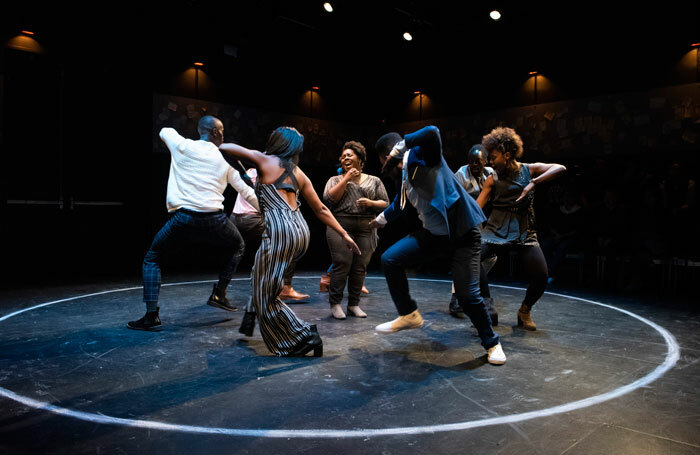
Also on this year’s roster, and completely sold-out, is the eight-performance New York return of Aleshea Harris’ What to Send Up When It Goes Down. The play received considerable acclaim when it premiered at the ART/NY Theatres in a production from the relatively little-known Movement Theatre Company.


An exploration of the racism faced, and the resilience demonstrated by black people in the US, it makes its intentions very clear from the start.
The opening lines of the play declare: “Let me be clear: this ritual is first and foremost for black people. Again. We are glad non-black people are here. We welcome you but this piece was created and is expressed with black folks in mind. If you are prepared to honour that through your respectful, conscientious presence, you are welcome to stay.”
It might seem a bit unusual for a play that was so topical and so well received in a previous full production in New York to reappear for a short run in a New York festival. It is perhaps even more remarkable to find that even before the stint at the Public took place, Playwrights Horizons, another major subsidised Off-Broadway venue, announced that it too would present What to Send Up, in late June and July of this year.
This succession of New York presentations is evidence of the value of the work itself, but it also speaks to the continuing evolution of how successful work is sustained in New York. Transfers of work from subsidised Off-Broadway companies to commercial Off-Broadway runs, once common, are now rare. The finite environs of Broadway mean that only so many pieces can – or should – make that leap. But that means New Yorkers often have very limited access to important productions.
The journey of What to Send Up has been fairly unusual, one that speaks to the recognition that it deserved a much longer life in New York and so new, cooperative models needed to be put into play.
Transfers of work from subsidised Off-Broadway companies to commercial Off-Broadway runs, once common, are now rare
Without involving multiple companies, this is like New York Theatre Workshop’s moving Heidi Schreck’s What the Constitution Means to Me from its East 4th Street home to the Greenwich House Theater. A commercial Broadway run followed that.
In the same spirit, The Vineyard Theatre brought back Is This a Room to its Union Square home for a return engagement over the holidays also ending this weekend. It had extended its original autumn run, which itself followed a short run at the Kitchen in early 2019.
In a tweet this week, Harris noted that other New York theatres had the script to What To Send Up and didn’t take it up before Movement agreed to produce it. It took Movement’s production to get it attention, though in a roughly 100-seat venue, in a limited engagement.
There’s no question that What To Send Up had a great deal to say to New York, and it has taken yet more not-for-profit companies to make that happen.
The question now is whether more companies have the willingness and resources to offer worthwhile Off-Broadway shows – ones that aren’t necessarily Broadway-bound – the opportunity for sustained lives, regardless of whether they began on their own stages or with another company. It’s a promising path to explore for Off-Broadway, a part of the industry that has been without a reliable model for long-running plays for far too long.
This week in US theatre
Kathryn Hunter takes on the title role in Shakespeare’s Timon of Athens at Brooklyn’s Theatre for a New Audience, opening Sunday, in the play’s first major New York outing in nine years. Simon Godwin directs this co-production with his Shakespeare Theatre Company in Washington DC, where it will be seen in late February and March.
The Atlantic Theater Company provides actor Eboni Booth with her Off-Broadway playwriting debut with Paris, the story of a woman who is one of the few black people in her small Vermont town. It opens Tuesday, directed by Knud Adams.
Winner of the Pulitzer Prize following its Negro Ensemble Company premiere in 1981, A Soldier’s Play by Charles Fuller was subsequently adapted as a 1984 film and revived Off-Broadway by Second Stage in 2005. It makes its Broadway debut on Tuesday via Roundabout Theatre Company with Blair Underwood and David Alan Grier in leading roles, directed by Kenny Leon.
Despite its long-running success in London’s West End, The Woman in Black never quite caught on in the US, managing only a two-month run Off-Broadway in the summer of 2001. It returns to New York for a Thursday opening at a pub venue within the sprawling McKittrick Hotel, longtime home of Sleep No More, under the direction of its original UK director Robin Herford.
Second Stage has really thrown its support behind playwright Bess Wohl, having given her Make Believe a New York premiere just last year and now providing Wohl with her Broadway debut. Grand Horizons opens on Thursday at the Helen Hayes Theater with Jane Alexander and James Cromwell leading a cast that includes Priscilla Lopez, Ben McKenzie, Maulik Pancholy, Ashley Park and Michael Urie, directed by Leigh Silverman.
Howard Sherman is a New York based arts administrator and advocate. Read his latest column every Friday at thestage.co.uk/author/howard_sherman/




Opinion
Recommended for you




Advice
Recommended for you
Most Read
Across The Stage this weekYour subscription helps ensure our journalism can continue
Invest in The Stage today with a subscription starting at just £7.99


© Copyright The Stage Media Company Limited 2026


