


 Howard Sherman
Howard Sherman, a veteran of US institutional theatres, is a New York-based arts administrator, writer and advocate. He is director of the
...full bio
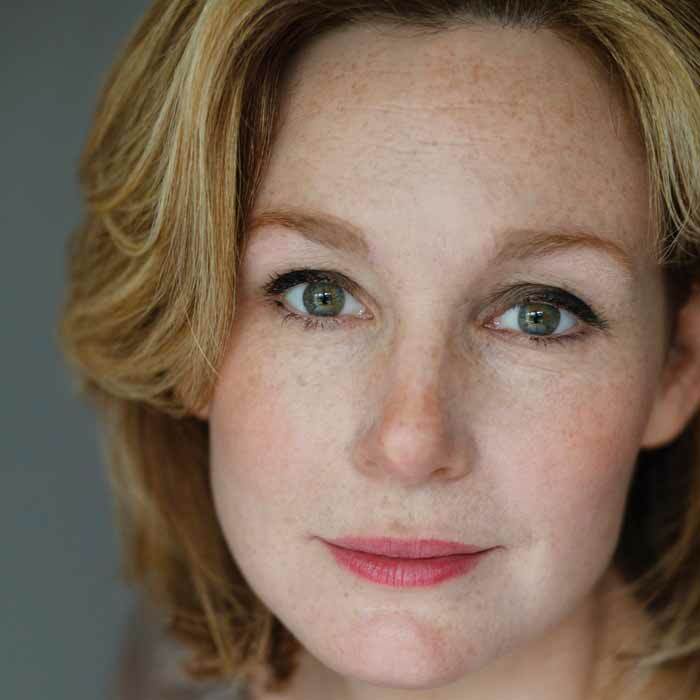
With her latest play Infinite Life about to premiere in New York before heading to London’s National Theatre and her debut film Janet Planet, which she also directs, completed, the Pulitzer Prize-winning playwright talks to Howard Sherman about her foray into film-making, artistic collaborations and why she is fiercely protective over where and how her work is performed


Howard Sherman, a veteran of US institutional theatres, is a New York-based arts administrator, writer and advocate. He is director of the
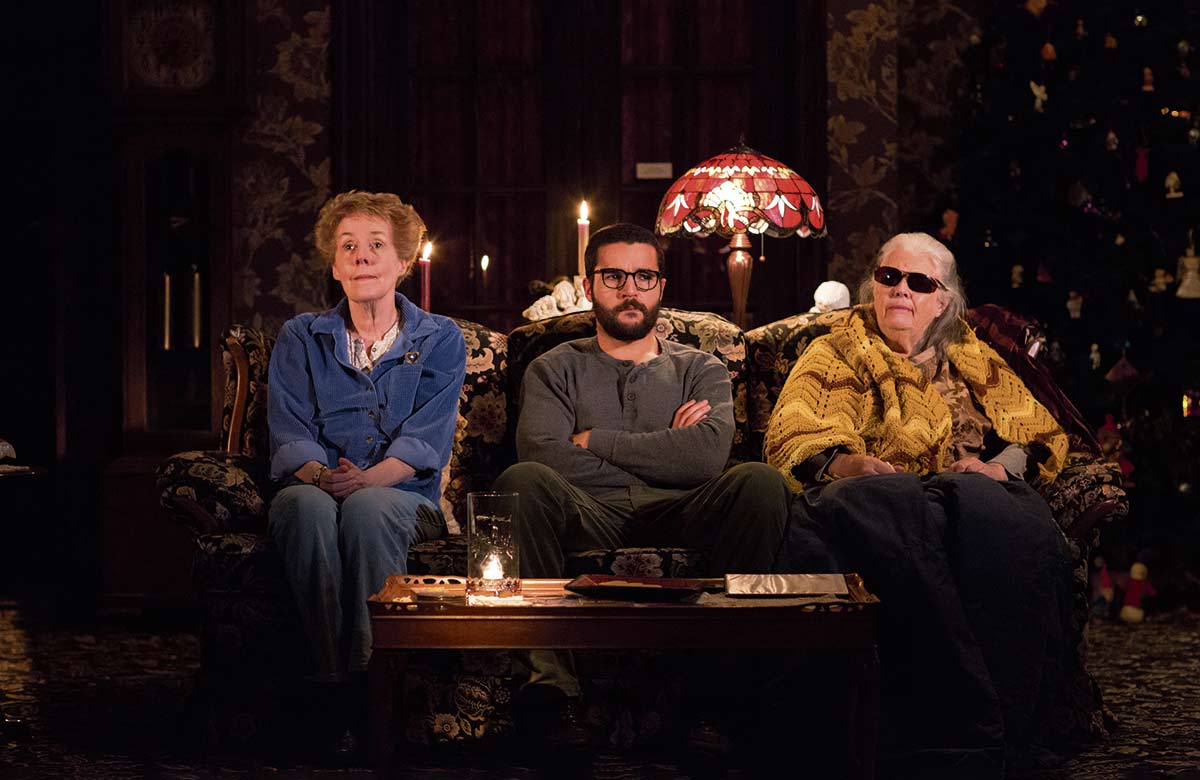
...full bioDespite what some might wish to read into its title, Annie Baker’s newest play Infinite Life is not her pandemic play. “I finished the play in 2018 or very early 2019,” says Baker in conversation after a rehearsal for the Atlantic Theater Company premiere of the piece, which begins previews this week in New York – the same production will play at the National Theatre in London in November. “I finished revising it in May 2019, right before my daughter was born. It’s a contemporary play – but there’s also a lot of stuff in it about pain and illness and it felt important to say that this is 2019.”
Of the long gap between completion and production, Baker says: “It’s been really interesting to live with this play over a period of time. There’s something delightful about it actually, and something odd about it too. To me, less important than the span of four years is the period of my life in which it was written, both pre-pandemic and pre-parenthood.”
The Atlantic’s website summarises Infinite Life as: “Five women in Northern California sit outside on chaise lounges and philosophise. A surprisingly funny inquiry into the complexity of suffering, and what it means to desire in a body that’s failing you.” While Baker prefers to not discuss specifics of the play in advance of audiences seeing it, she’s aware that Infinite Life will now be viewed through a different lens than when she wrote it.
“There are certain lines that mean things they didn’t mean five years ago,” she says, “and to my surprise, I’m finding that enjoyable. But it’s odd and interesting.”
Infinite Life may not be her Covid play, but Baker does have a pandemic-era work that’s forthcoming: Janet Planet, the first film that she’s written and directed, featuring Julianne Nicholson and Sophie Okonedo in leading roles, filmed in and around Amherst, Massachusetts, where she was raised. Describing herself as a film nerd as a child, with theatre coming later, Baker was clearly energised by her experience working in a different medium.
“I was directing a movie for the first time, so there is a real naïveté,” she recounts. “I mean, I knew nothing. Yet film was my first love. I’ve seen a million movies and have a million opinions about them and that felt like a very different way to enter the form.”
Related to this article

Mind-altering experiences
She continues: “It was fast and the whole thing was fascinating. I do feel like I learned [a lot] in the past two years, just the amount of information, new words that I didn’t even know the meaning of before that now live in my head. It’s sort of extraordinary. I feel like I have had these somewhat mind-altering experiences: first bearing and raising a child then the pandemic, then totally finding myself in a new medium. And now returning to the medium that I made my career and that I love deeply and it both being familiar and unfamiliar after those experiences.”
Having sat in the director’s chair, is it an experience she wants to repeat, on film and on stage?
“I have no desire to direct the work of other people on stage,” she makes clear. “I do have the desire to direct my own work on stage and I have in London.” With designer Chloe Lamford, she co-directed The Antipodes at the NT in 2019. “I was really excited to work with James Macdonald in particular on [Infinite Life], especially after such a long period of time had gone by since I wrote it. It felt really important to bring in another collaborator and he’s so lovely and understood the play on a very intuitive level.”
It is not her first collaboration with British director Macdonald – he has worked on two of her previous plays: 2018’s John at the NT and the 2013 European premiere of Circle Mirror Transformation at London’s Royal Court.
“I’m very interested in directing my own work in theatre and in film, but not exclusively,” she continues. “I’m interested in co-directing, I’m interested in what it would mean for a group of people to direct a play together, obviously with certain roles – I would be interested in directing a play with, like, three other people at some point. I really love working with designers. I continue to be interested in what it would be like to start building a play with designers early enough that you could say: ‘Yeah, we all directed this together,’ to not take full credit as director and to make it about a team. But James is very much directing this play.”
Having started out as a youthful film buff, Baker credits her discovery of theatre to an inspirational high school drama teacher, who she says made the art form accessible to her – that included his introducing the students to the work of Caryl Churchill, including an ultimately failed effort to produce Churchill’s Blue Heart at the school before the two one act plays had even had a professional US premiere.
Baker says: “Theatre was the art form that was accessible to me. Theatre was what I could make for nothing as a teenager and I fell in love with it. It’s such a strange art form that I still can’t wrap my mind around. There’s something so mysterious about it. And I feel like whenever I read, whenever people talk, about what theatre is or what theatre means, it’s part of fundraising efforts or something on theatre websites. I’m always like: ‘That’s not quite right.’ There’s something much stranger about it and more abstract and philosophical than any of us are putting our fingers on. It’s something having to do with time and experience.”
For college, Baker went to New York University Tisch School of the Arts, majoring in dramatic writing because of the expense involved in majoring in film. “You had to produce your own movies and it was so clear that the rich kids would be able to. It just seemed impossible for someone who didn’t come from wealth to make movies as an undergrad.”
She felt the coursework at Tisch was rather conventional, a step backwards from her progressive high school experience. Feeling discouraged, she ultimately minored in history and religion. “I found that that helped my writing more than studying writing,” she says.
Q&A
What was your first non-theatre job?
I was 15 and I got a job working at the bakery in my hometown.
What was your first professional theatre job?
My freshman year of college, I was a stage manager at La MaMa.
What is next for you?
The release of the film Janet Planet.
What do you wish someone had told you when you were starting out?
Always stay connected to your own taste and what gives you pleasure, even if you think no one else will like what you’re doing.
Who or what is your biggest influence?
Thomas Mann, Western Massachusetts, my daughter.
If you hadn’t been a playwright, what would you have done?
I might have gotten a master’s in divinity. I’ve always fantasised about being some kind of radical rabbi. Also, maybe a private investigator.
Do you have any theatrical superstitions or rituals?
Because I am a very superstitious person, I think if I started to develop any kind of superstition around the theatre it would spin out of control.
Freedom and experimentation
Next came a graduate degree in playwriting at Brooklyn College, a move driven by the opportunity to study with playwright Mac Wellman, and to have a degree that would make it possible for her to earn a living. Of Wellman, who she had first encountered in a class at the Off-Off-Broadway Flea Theatre, Baker says: “The way he talked about making work reminded me of a kind of freedom and experimentation I hadn’t been in touch with since I was a kid. And so that was what brought me back to grad school.”
As for a career, she says: “If I had an MFA, it would make it a lot easier to get a teaching job. I find it’s related to realising quite early on that I wasn’t going to have a career, or I wasn’t going to have any pleasure having a career, on Broadway or in Hollywood. Those places are not for me and my work is not for those places. I was trying to figure out how I could write the kind of plays I want to write and also support myself.”
She did get a teaching job – she is associate professor of practice on the MFA playwriting programme at the University of Texas and has taught playwriting at several other US universities.
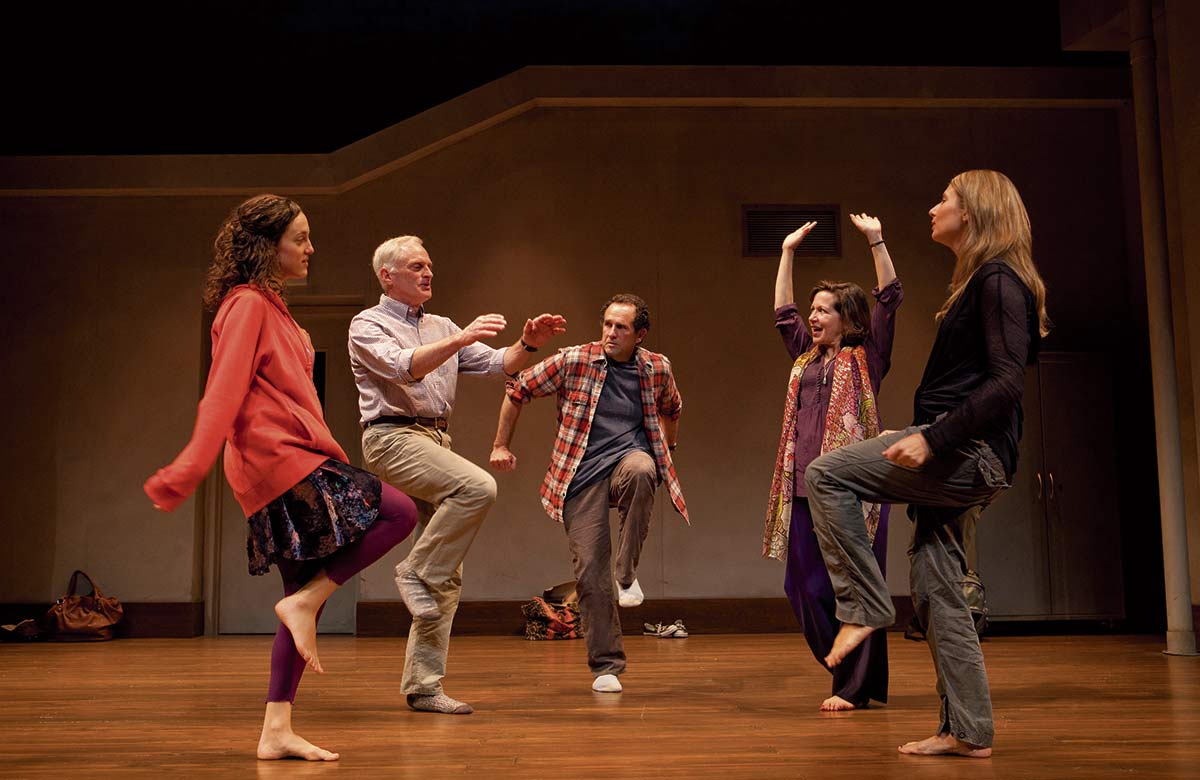
While she was still studying at graduate school, Baker had her first professional production, Body Awareness, at the Atlantic in 2008. Circle Mirror Transformation at Playwrights Horizons and The Aliens at Rattlestick quickly followed, which she admits was surprising for someone just starting out. “I think I was 29. It seems very young to me now. I see students now getting productions right out of undergrad, and that must be really hard. I wouldn’t have been able to deal with that when I was 23. I barely could deal with it when I was 29.”
‘There’s something much stranger and more abstract about theatre than any of us are putting our fingers on’
A close look at Baker’s résumé beyond theatre also reveals some interesting side jobs, most of which she says she found by being quick to respond when ads were posted on Craigslist, including being a nanny, a camp counsellor and working in a bakery. Her pragmatic approach to work and making a living saw her getting her health insurance through the first half of her 30s through the Writers Guild by taking on some film and TV assignments. She describes them as negative experiences but says they also confirmed for her that she wouldn’t enjoy doing that kind of work. During this period, she worked on the television competition shows The Bachelor and Who Wants to Be a Millionaire?, although Baker points out that the former was only a brief stint of a few weeks.
Of the latter, she says: “Who Wants to Be a Millionaire? was a few years of my life and a very meaningful job. Fact checking and research is really interesting work. I still think about it a lot and I think I learned a lot from it. I love to research. I got to go to the public library a lot and look through their archives. It was great. It supported me. They were on eight months a year and off four months a year, and I would get unemployment during my four months off. That’s how I could write plays.”
Consecutive premieres
Body Awareness, Circle Mirror Transformation and The Aliens premiered in consecutive years between 2008 and 2010, with Circle Mirror quickly receiving numerous productions – did Baker see many of them? “There was an initial desire that was mostly curiosity,” she says, but she soon decided against it on an ongoing basis. “I shouldn’t visit rehearsals or see a performance of a production that I haven’t been heavily, heavily involved in from the beginning. I work really hard on my productions in New York. I’m incredibly protective over where and how they’re performed in London, and who directs them. I’m involved from the beginning heavily with those productions and there for all of rehearsals. I’ve had barely any productions in Los Angeles because I’m so protective over who directs them that they just haven’t happened. Otherwise, I’ve kind of just left it.”
‘I’m interested in directing my own work in theatre and in film, but not exclusively. I’m interested in co-directing’
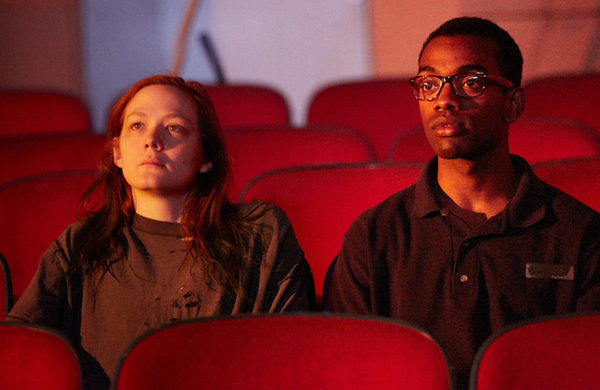
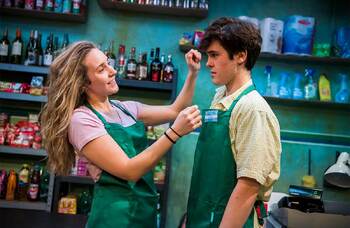
Given her upbringing and her love of film, Baker’s 2013 play The Flick, set in a cinema and following three of its ushers, seems like it was a natural subject for her – though, among her many subsistence jobs, working in a movie theatre was not one of them. Among the play’s many themes is change in the lifespan of art, coming at a time when film projection fully gave way to digital projection.
“I feel like all of my plays come out of some kind of philosophical struggle I’m having with, you could say, reality or with my experience of reality. Theatre can be a really ripe way to explore abstract thought. So The Flick – the inspiration was first watching some ushers clean up after a show and banter with each other and that feeling like a really amazing piece of theatre. That felt like an amazing chunk of real-time following a chunk of past-tense time I just saw on the screen and that clash of present tense and past tense was really interesting to me, and then the transition that was starting to happen between. So I think I started writing it in 2009 or 2010, finishing in 2012. During the writing of the play, film projectors were being thrown out on the street and it was just wild. I could never have predicted how fast it would happen.”
While The Flick went on to receive the Pulitzer Prize for Drama, its initial run at Playwrights Horizons was the topic of much conversation when the company’s artistic director sent a message to the theatre’s subscribers urging them to be patient with Baker’s deliberate storytelling pace, noting the play’s “long silences between lines” and its three-hour running time. In retrospect, what does Baker make of the kerfuffle?
“I feel like the controversy was largely fabricated, but there are a lot of walkouts during my plays. Not during The Aliens because the audience for the Rattlestick Theater was very different, at least at the time, than the audience at Playwrights Horizons, so it also just depended which theatre I was working at.” Baker shrugs the whole thing off. “I’m not really that upset when people walk out of my plays, not because I’m some kind of provocateur, but just because it doesn’t offend me.”
Teaching process
She demurs when asked to characterise the kinds of plays she sees emerging from those she teaches, in part because the sample is too small from which to draw any consensus, preferring instead to discuss her teaching process. “I think part of being a good playwriting teacher is like being a good analyst, and there’s a privacy to that. I do think my job as a teacher is to help them think about what kind of plays they genuinely enjoy writing and seeing, and not what kind of plays other people think they should write, or they think they should write. I feel like that has been a problem since the beginning of time that young people think there’s a certain kind of person they need to be or a certain kind of work they should be doing. Part of getting older is liberating yourself and your role as an artist, or as much as you can, from anxiety about your ego identities. That sounds very much like an analyst, but I think it’s important and there’s only so much you can do that as a teacher.”
With her movie completed and Infinite Life about to premiere, will Baker turn to stage or screen next?
“I’m really excited to go back into a writing foxhole once the play has come out, once the movie has come out, and to go into a more contemplative private space for another couple of years at least,” she says. “I definitely know what my next movie is going to be. I know what the next play is going to be. But I haven’t written them yet. They’re just being written in my head until I have the time.”
CV Annie Baker
Born: 1981, Cambridge, Massachusetts
Training: NYU Tisch School of the Arts, BFA (2003); Brooklyn College MFA (2009)
Landmark productions:
• Body Awareness, Atlantic Theater Company, New York (2008)
• Circle Mirror Transformation, Playwrights Horizons, New York (2009), Royal Court Theatre, London (2013)
• The Aliens, Rattlestick Playwrights Theatre, New York (2010)
• Uncle Vanya, Soho Rep, New York (2012)
• The Flick, Playwrights Horizons (2013), National Theatre, London (2016)
• John, Signature Theatre, New York (2015), National Theatre (2018)
• The Antipodes, Signature Theatre (2017), National Theatre (2019)
Awards:
• Obie award for best new American play for Circle Mirror Transformation and The Aliens (2010)
• Steinberg Playwright Award (2013)
• Pulitzer Prize for The Flick (2014)
• Guggenheim Fellowship (2014)
• MacArthur Foundation Fellowship (2017)
Agent: Rachel Viola, United Talent Agency
Infinite Life premieres at Atlantic Theater Company, New York on August 18 (atlantictheater.org) and at the National Theatre in London on November 22 (nationaltheatre.org.uk)

Big Interviews
Michael Sheen
Annilese Miskimmon
Adele Thomas and Sarah Crabtree

Sutton Foster
Julian Bird
Recommended for you
Opinion
Most Read
Across The Stage this weekYour subscription helps ensure our journalism can continue
Invest in The Stage today with a subscription starting at just £7.99

© Copyright The Stage Media Company Limited 2026


