


Sustainable Stages: what makes a great climate play?
In the fourth column as part of a series focused on sustainability in theatre, Amber Massie-Blomfield explores the shift away from browbeating climate narratives as writers seek to inspire solutions and hope rather than anxiety and guilt



What makes a great climate play? It is a question I have been asking a lot in recent months as I think about the role of theatre in driving change on environmental issues. The author Amitav Ghosh has written that “the climate crisis is also a crisis of culture, and thus of the imagination”. I agree with him.
There is a powerful connection – increasingly recognised by climate policymakers and funders – between the stories a society tells itself and how it chooses to live. Tackling the climate emergency demands we go beyond technological and economic solutions; we also need ways to think deeply about the implications of being a human in this unprecedented historical moment. This is the work of storytellers, including theatremakers.
Yet most people I speak to struggle to name more than a handful of great plays with climate change as a theme. Many have a preconception about what a climate play is – too didactic, too sombre, too many sad polar bears. At a recent event for London Climate Action Week, discussing his TV show Toxic Town, playwright and screenwriter Jack Thorne distanced himself from the idea of being a “climate writer”, making light of his experiences as a co-writer of 2011’s Greenland, which he described as one of the worst-reviewed plays the National Theatre has ever staged. I didn’t see it, but reviews suggest it hit all the tropes of bad climate theatre – a browbeating drama about human guilt and anxiety in the face of the crisis with not a lot of jokes (and, yes, a polar bear).
Continues...
Read More

Climate plays don’t have to be like this – as director Elizabeth Freestone and writer Jeanie O’Hare set out to prove with their book 100 Plays to Save the World, a collection of essays about the genre. Following a call-out, they received hundreds of script submissions. “It completely blew my mind,” says Freestone. “It was such a dazzling array of genres and styles; hilarious, strange, funny, absurd, magical realism – you name it.”
The collection offers a sense of the variety of what a climate play can be, including a sci-fi drama about robots taking over the Earth (Karel Čapek’s R.U.R.), a lecture-gig about the colonial causes of the water crises in the SWANA region (Sabrina Mahfouz’s A History of Water in the Middle East), an exploration of the relationship between faith and climate change (Kia Corthron’s A Cool Dip in the Barren Saharan Crick) and a play about Dionysus being reincarnated as a gender-queer landscape gardener (Madeleine George’s Hurricane Diane).
It is perhaps helpful to remember that climate plays are not a recent phenomenon. Freestone and O’Hare’s book highlights Aeschylus’ The Suppliants, August Strindberg’s Easter and Bertolt Brecht’s The Caucasian Chalk Circle, alongside more modern works. Freestone has also just published Performing Shakespeare on an Endangered Planet, co-authored with Katherine Steele Brokaw, which positions William Shakespeare as an eco-playwright, underlining the significant environmental upheaval that happened during his lifetime and how present it is throughout his plays. After all, we have always been deeply connected to the rhythms of nature and impacted when they are disturbed.
Toby Litt argues that another narrative key theme has been around the need to shift away from the dominance of the hero’s journey, which is seen to reinforce the individualism that dominates Eurocentric cultures
“A great climate play is a funny one, a strange one, an unexpected one,” Freestone tells me. She is adamant, however, that dystopias – such a favoured form in climate narratives – are “irresponsible and also really boring as a genre”. That perspective is shared by many working at the meeting point of climate and storytelling, who argue that instead of sounding the alarm about the future we are currently heading for, the job of artists and writers is to help us imagine the future we want and, crucially, what the journey to get there will be like.
Philosopher Rupert Read coined the term “thrutopias” to describe this kind of story. “Thrutopias would be about how to get from here to there,” he wrote in a 2017 essay on the topic. “How to live and love and vision and carve out a future.” This has been attempted on stage – for example, in The World We Made by Beth Flintoff, adapted from Jonathon Porritt’s book. Told from the perspective of 2050, the play recounts how humanity travelled from the world we have today to a genuinely sustainable future.
Another key theme for thinkers on narrative and systemic change has been around the need to shift away from the dominance of the hero’s journey, which is seen to reinforce the individualism that dominates Eurocentric cultures and is the core of our problems, as argued by Toby Litt in his book How to Tell a Story to Save the World. A great climate play might focus on form and ensemble storytelling and contribute to a deeper narrative shift in how we understand our role in relation to others and how we can bring about change.
Continues...
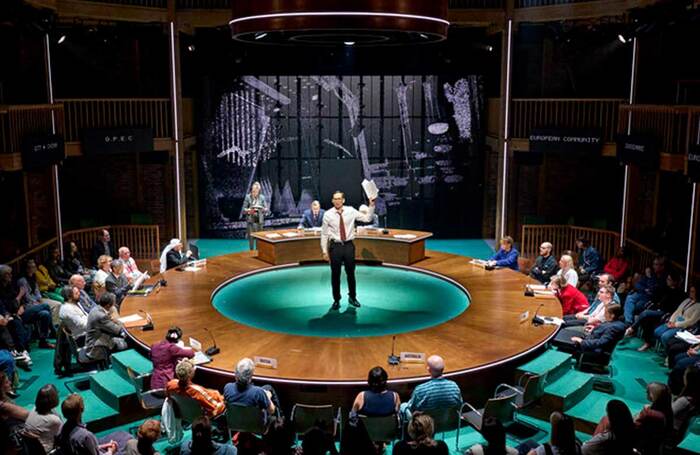
While this kind of systemic thinking around storytelling is no doubt important, I share with Freestone the view that, first and foremost, what makes a great climate play is the same as what makes any play great – that it is entertaining. The success of Good Chance’s Kyoto in the West End rests on the fact that it is a really exciting (anti-)hero’s journey that happens to be about climate policy. Consequently, tens of thousands of people now have a grasp of the mechanics of international policy negotiation and the vital importance of working through differences to find solutions to the problems we hold in common.
A new musical coming to the Edinburgh Fringe promises to be another great example of how entertaining the genre can be. Rarely has climate change been considered a fitting subject for musical theatre, but Hot Mess seeks to change that with its boy-meets-girl romcom with a twist. In this telling, the love affair is between Earth and humanity. The whimsical plot has a profound question at heart: what does it mean to be in love with our planet, and what happens when that relationship goes wrong? “The challenge is how do you engage people in this subject matter where people might feel a bit like: ‘Oh, I’m going to be lectured to,’ or: ‘It is going to be bleak, and I’m not going to have a good time’?” says co-writer Jack Godfrey.
Playwrights best serve the environmental cause not by giving us the answers but by giving us a place to sit together for an hour or two with the messiness, the difficulty and the hope, without judgement
Complete with a banging pop score, Hot Mess is tongue-in-cheek, with characters that are flawed but likeable. From a climate perspective, what’s most exciting is its potential to appeal to a wide audience, including those unlikely to keep track of the latest IPCC report or COP gathering – or, indeed, to go to a straight play like Kyoto.
“I wanted to write something that is very pop culture, for people, not just for theatre fans,” Godfrey says. “It’s important that the play inspires action – my absolute nightmare with this show is that everyone comes along and, at the end, they’re like: ‘What a great show’, and then completely don’t engage with the issues at all,” he tells me. The most effective way for theatre to do that is “to give people a bunch of images and thoughts and ideas, and then you can go away and think about it yourself. We’re generating conversations without ever saying: ‘This is the message of the show’”.
Godfrey’s words make me think that this may be the issue at the heart of it all: the scale of the problem is so great that anything less than a stark confrontation with the facts or a call to immediate action seems disproportionate. But environmental psychologists have demonstrated that this approach doesn’t work. As Renée Lertzman highlights, most of us have a psychological “window of tolerance” for anxiety and stress. When it is exceeded, we shut down. Nor does it make for a great night at the theatre.
Playwrights best serve the environmental cause not by giving us the answers but by giving us a place to sit together for an hour or two with the messiness, the difficulty and the hope, without judgement. All the better if they throw in a few good tunes.





Most Read
Across The Stage this weekYour subscription helps ensure our journalism can continue
Invest in The Stage today with a subscription starting at just £7.99

© Copyright The Stage Media Company Limited 2026


