


The Flying Dutchman review


Welsh National Opera’s music director goes out with a bang


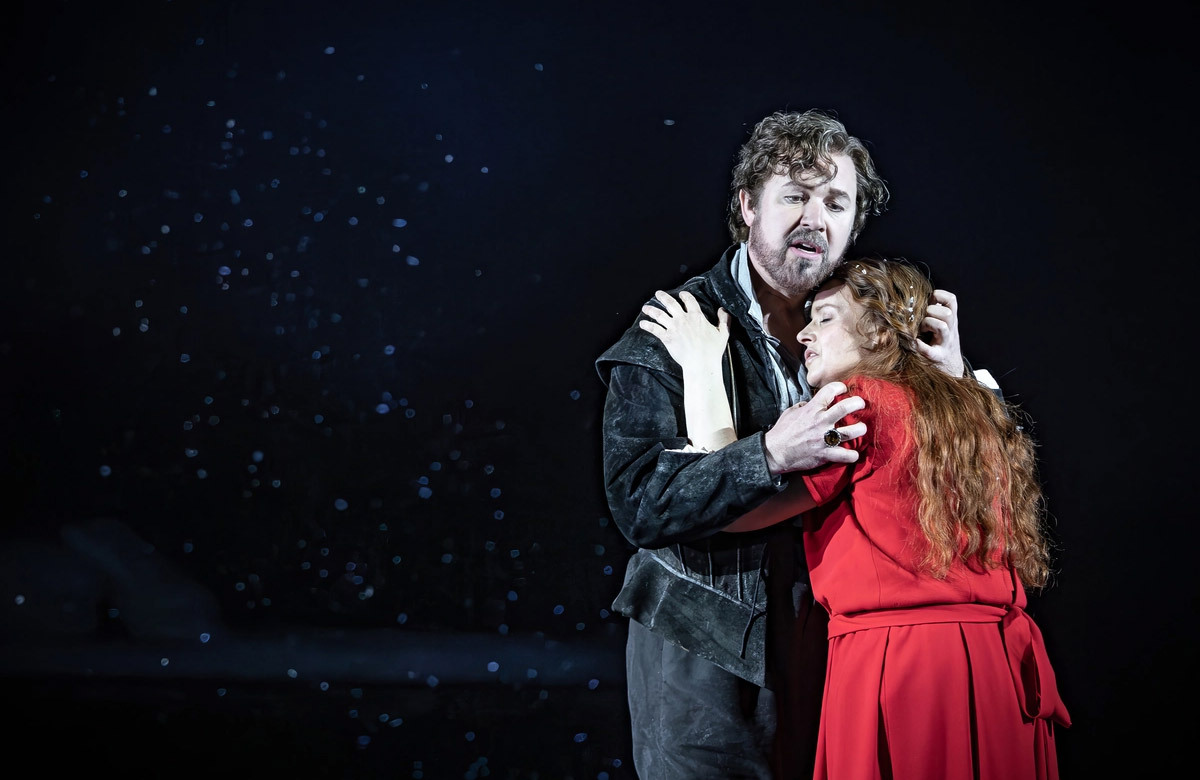
During Wagner’s fierce storm-at-sea overture, we see a woman give birth. She dies, her child grows, dons a red dress and eventually runs around the stage in wide circles. The daughter is Senta, whose unswerving obsession with the legend of the Flying Dutchman – an accursed sea captain, doomed to sail the seven seas for eternity unless he can find a woman who will love him unconditionally, and thereby release him – binds the two of them together in fatally exclusive attraction. It’s an arresting image that returns at the very end, just before Senta dies on what is intended to be her marital bed.
With simple, striking designs by Elin Steele, lit with imaginative skill by Lizzie Powell, Jack Furness’ staging is founded on visuals that match the emotional grip of Wagner’s score in scenes alternating between absolute stillness and startling vitality. Lashings of dry ice help conjure the Gothic horror atmosphere. A nice touch is the Dutchman’s archaic dress – he has, after all, been engaged on a desperate quest for salvation for centuries.
Continues...
Read More
Even in this relatively short opera, Wagner’s demands on his singers are tremendous, but impressively met by this cast. Simon Bailey’s relatively lightweight bass-baritone possesses the tensile vigour and staying power to summon up a sinister, yet curiously sympathetic Dutchman. Although the odd passage taxes her along the way, Rachel Nicholls traverses with confidence the arduous role of psychologically disturbed Senta.
As her cast-off admirer Erik, Leonardo Caimi’s tenor overcomes minor blemishes to create a positive overall impression. James Creswell’s orotund bass supplies the firmest of lines for Senta’s father Daland’s materialism to register perfectly. Trystan Llŷr Griffiths delivers the small role of the Steersman ideally, giving promise of greater things to come: he’s certainly a tenor to watch.
This is also a great night for two of Welsh National Opera’s chief assets, its long-famed chorus and its invincible orchestra. Invariably exciting, the choral sections rise to awe-inspiring climaxes, while Rebecca Meltzer’s challenging movement in the scene when the two ships’ crews confront one another is realised vividly from both a physical and a musical point of view – a true highpoint of the evening.
Equally, the orchestra meets the full Wagnerian challenge head-on, with Tomáš Hanus – the company’s music director for the last 10 years – in total command of his forces.
As the curtain applause reaches its peak, Adele Thomas and Sarah Crabtree, WNO’s joint general directors and CEOs, salute Hanus in what is his final production in his current position. Their brief, but apposite tribute acknowledged both his adherence to the highest standards and also his eloquence and bravery in standing up for the company in difficult times. He will not be easy to replace.
For full touring dates, click here
For all the latest theatre reviews, sign up to The Stage’s weekly reviews newsletter

Most Read
Across The Stage this weekYour subscription helps ensure our journalism can continue
Invest in The Stage today with a subscription starting at just £7.99

© Copyright The Stage Media Company Limited 2026


