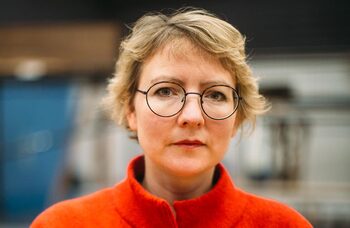
Lu Kemp, artistic director at Perth Theatre, tells David Pollock about her next season for the Scottish theatre and why she has chosen to kick it off with Oscar Wilde’s comedy The Importance of Being Earnest
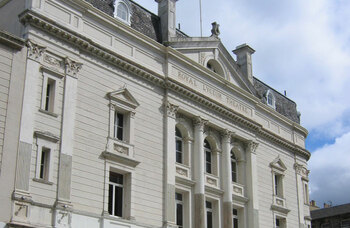
It’s a poignant reminder of Perth Theatre’s distinctive sense of place, that Lu Kemp describe’s an incoming production of Macbeth as a “local play” – both Birnam Wood and “high Dunsinane hill” are close by in the Perthshire countryside. It feels right that this small but historic city should have a theatre dedicated to original and thought-provoking productions, and not just act as a receiving house.
“It’s like an almighty juggling act,” says Kemp of the role she’s held at Perth since the theatre reopened in 2017 after a major refurbishment. (Its previous incumbent was Rachel O’Riordan, who is now at the Lyric Hammersmith following a stint at the Sherman Theatre in Cardiff.) “But out of restriction you get some really interesting outcomes, don’t you? You might need to rethink how you approach some things, but then the very heart of the piece is accentuated by the choice you have to make in how you perform it.”
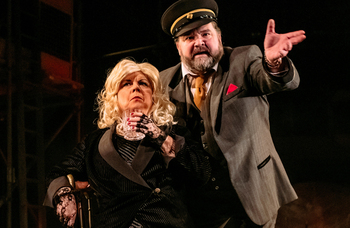
Kemp is talking generally but also refers specifically to Perth Theatre’s new production of Oscar Wilde’s The Importance of Being Earnest, which she is directing. The cast is led by Karen Dunbar as Lady Bracknell, whose comic roles on Scottish television are balanced by experience playing Shakespeare at the Donmar Warehouse and in Men Should Weep at the National Theatre. Elsewhere the play’s many roles are shared between four other actors; a case-in-point regarding what Kemp says about limited resources requiring ingenious solutions, given the play’s focus on dual identities.

“At the moment we’re in a difficult time politically, and it feels like we want to escape, to enjoy ourselves, so it felt important to programme comedy,” says Kemp of making The Importance of Being Earnest the centrepiece of Perth’s spring season. “I was looking at comedies that had content but allowed people to laugh and realised Earnest is absolutely a classic, but that it also feels completely relevant. One of the great lines is: ‘Untruthful? My nephew Algernon? Impossible. He is an Oxonian’, so there are all of these ‘pings’ that an audience will recognise.
“It’s about performance of self. Lady Bracknell forces herself into being, doesn’t she? It’s not like a stiff Noel Coward; it’s funny, it’s fast, it has attack. Wilde says it should go like a pistol shot. The more work we can do of that kind – that takes really big stories and looks at them in a new light – the more we’ll be able to talk to an audience who are asking us for big classics, but who are engaged in what our cosmopolitan world is at the moment.”
Continues…
What was your first non-theatre job?
Plucking turkeys at Christmas.
What was your first professional theatre job?
As a Scottish Arts Council trainee director at TAG Theatre, formerly the touring arm of Citizens Theatre, Glasgow.
What do you wish someone had told you when you were starting out?
What the role of the production manager is.
Who or what was your biggest influence?
Everything I read up to the age of 10.
What is the best advice you’ve been given?
You have to be prepared to be shit to be good.
If you hadn’t been a director, what would you have been?
A wildlife photographer.
This is Kemp’s first job as artistic director, although her career in theatre has been extensive and varied. Born in Watford, she was inspired first by her mother, a physiotherapist who emigrated from South Africa at the age of 21 and was a naturally gifted storyteller. As a child, the only treat Kemp wanted was to be taken to see Cats, and she practised “terrible arabesques” at roller dance, in the hope she would be spotted for Starlight Express.
She studied politics and philosophy at Edinburgh University, eventually shifting to an English degree, while working as an usher at the city’s Traverse Theatre. One colleague at the time was the future playwright Robert Alan Evans and together they staged student work at Edinburgh University’s Bedlam Theatre. This included a version of The Hunting of the Snark, which did well at the Edinburgh Fringe, and the National Student Drama Festival, which earned her a trainee directorship at TAG Theatre, part of the Citizens Theatre in Glasgow. She worked as assistant director to James Brining on plays by David Greig and Stephen Greenhorn, and eventually moved to BBC Scotland as a producer, “which, in radio drama, means you do everything – you direct it, you cast it, you administrate it, the whole lot”.
A desire to explore more physical aspects of her craft than writing led Kemp to study first at the Jacques Lecoq School in Paris, and then with Saratoga International Theater Institute in New York. “SITI was a brilliant move for me,” she says. “They approach work as a coalescence of all the forms that theatre takes – the physical, the textual, the oral, the sensual – and they make work that brings that together, so it’s a compositional course.”

That was just over a decade ago, and was the only time in her career that Kemp has been based anywhere other than Scotland. When she returned, newly invigorated, she balanced freelance work with her own productions, in particular work for children, such as an acclaimed 2009 version of the story One Thousand Paper Cranes made “with a grant of £2,000 from Imaginate, the Edinburgh International Children’s Festival umbrella organisation. I really owe them my career”.
If That’s All There Is was produced by Inspector Sands and the Traverse Theatre, while she and Oliver Emanuel’s version of the Flemish play Titus was made “for £50 as a rehearsed reading at a scratch performance”.
“What shifted in going into theatre for the second time after radio was that there had to be more of a reason for having a conversation with an audience,” she says. “We made A Thousand Paper Cranes because I wanted to make a show about death and grief for seven year olds. Earnest is about the ruling classes lying with bare-faced cheek, and that also feels very relevant.”
Away from the well-developed theatrical scenes in Edinburgh and Glasgow, and the ever-reliable Dundee Rep, theatregoers in Perthshire are better served than those in the rest of Scotland. Perth Theatre – which is linked to the nearby Perth Concert Hall through the publicly funded Horsecross Arts organisation – is less than half an hour from the equally renowned Pitlochry Festival Theatre, currently working wonders under its artistic director Elizabeth Newman. Yet there’s no university in the area, and most of the inhabitants are spread across well-to-do small towns and villages.

“A lot of people are moving back to Perth, because it’s a cheap and lovely place to raise your family,” says Kemp. “There’s definitely an older audience here, but as with most places, it’s about how you serve the existing audience and find new audiences as well. We’ve had real success in building children’s theatre at Christmas and Easter here, it’s been joyous to see.” Other recent successes have included playwright Morna Young’s deeply personal Lost at Sea, which won the Critics’ Award for Theatre in Scotland, and Rona Munro’s Frankenstein adaptation, a joint production with Selladoor and the Belgrade in Coventry.
Such link-ups are a boost to the sector, says Kemp. “We don’t have the money to do the kind of full seasons the Lyceum [in Edinburgh] or the Citizens Theatre do, we don’t get the same sort of funding,” she says. “You have to hope you can then populate this place and get the through flow and enjoyment of audiences that then helps us to produce more work.”
As well as Queen’s Theatre Hornchurch and Derby Theatre’s touring production of Macbeth, she’s also secured a run of playwright Peter Arnott’s The Signalman before summer, which was acclaimed during its recent run at Glasgow’s A Play, a Pie and a Pint. Had she more resources, however, Kemp would love to evolve the theatre’s production opportunities out of the main theatre and into the bar where we sit, with another stage for small, informal performances.
She buzzes at the sense of potential in her small but proud regional theatre. Ask Kemp where her stage practice lies, and she’ll tell you she’s a director, but “I don’t think these things are as divisible as we think they are,” she says. “It’s all one form, it’s just that my strongest hand is in visual storytelling and the interpretation of text. It’s a real privilege to do the job I do, it’s never static. I constantly have to revise my thinking and shift and rework things as we learn what works.”
Born: Watford, (year undisclosed)
Training: Edinburgh University; Jacques Lecoq, Paris; SITI Company, New York
Landmark productions:
• If That’s All There Is, Traverse Theatre, Edinburgh (2009)
• Bondagers, Royal Lyceum, Edinburgh (2014)
• Knives in Hens, Perth Theatre (2018)
Agent: Jo Probitts
The Importance of Being Earnest is at Perth Theatre until March 21. horsecross.co.uk
Invest in The Stage today with a subscription starting at just £7.99