


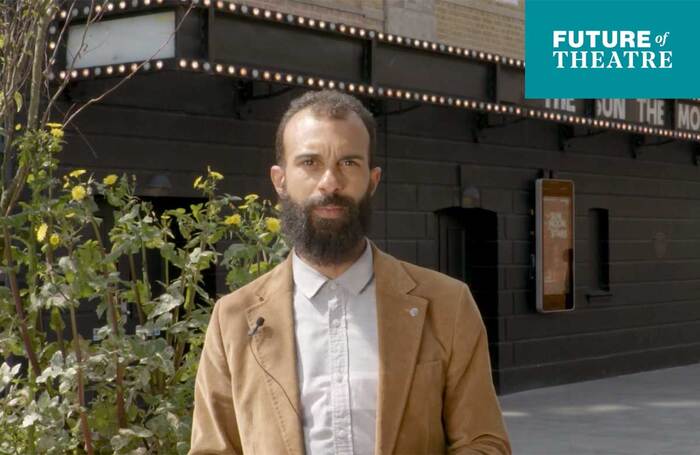
Matthew Xia: ‘True change must include access to power as well as opportunity’
For decades, the theatre sector has responded to accusations of institutional racism with half-hearted measures and token gestures, says Actors Touring Company’s Matthew Xia – action, not promises, is needed at all levels to ensure our industry reflects the whole of British society


The naivety of youth can be a gloriously protective thing.
I remember walking along to Theatre Royal Stratford East, my local theatre, and pressing my nose against the glass, peering into the Portakabin next to the main building, where the youth theatre was run from. It was 1993 and although my adolescent nerves were high at the prospect of meeting new people, I wasn’t concerned with ideas of standing out, or being different – after all, everyone in that room, to a greater or lesser degree, was “local”.
Newham in the early 1990s, pre-Olympic gentrification, was an impoverished area (one of the three most deprived boroughs in the country) hosting a gloriously multicultural set of communities from British imperial colonies who had come to the UK following the Second World War. I mention this simply because it set some high expectations for what a theatre could be.
TRSE artistic director Philip Hedley had created a space that mirrored the world beyond the walls of the theatre and, to use his terms, this was based on Joan Littlewood’s “continuous loop”: the idea that a cultural organisation should “draw ideas, concerns and talents from its community and concoct shows that connect back to that community”.
I wish, at the time, I understood how incredibly lucky I was to have walked into that theatre – offices, corridors, desks and stages filled with the same people that walked through the old shopping centre. With regard to demographics, there was no distinguishable shift as you walked through the entrance, nor was there one as you slipped backstage through the pass door.
What Philip Hedley was describing in the 1990s wasn’t a new revelation – in 1978 Naseem Khan’s report The Arts Britain Ignores included recommendations for systematic change
I was surrounded by inspirational people who had been embraced by the theatre: Clint Dyer, Ultz, Kerry Michael, Murray Melvin, Dawn Reid, Robbie Gee, Eddie Nestor and the Posse, Paulette Randall, Indhu Rubasingham, Michael Buffong, Omar Okai, Trish Cooke, Yvonne Brewster, Roy Williams, Kristine Landon-Smith, Jenny Sealey, Clarke Peters, Jo Melville, Jo Martin and the Bibi Crew, Arawak Moon, Amani Naphtali, Tunde and Ade Ikoli, Caro Parker, Keith Khan, Pravesh Kumar, Jatinder Verma… the list goes on.
And then, sometime towards the end of the 1990s – as I came to the end of my own adolescence – Philip Hedley, the man who was the leader of all I have described, said the British theatre sector was “institutionally racist”.
What Philip was describing wasn’t a new revelation. In 1978 Naseem Khan had published The Arts Britain Ignores, a 166-page report for the Arts Council complete with recommendations for systematic change. It’s worth noting that the official response to Naseem’s report said “we are reviewing her recommendations and think her report deserves careful consideration”.
Continues...
Related to this article


The illusion of change
The Stage had reported on accusations of ‘institutional racism’ as far back as 1987, and here we are in 2021 having the same tired, circular conversations. This time prompted by a series of knee-jerk promises made in response to the murder of George Floyd.
But, before I speak about last summer, there is another major point on the timeline.
The Eclipse report was published following a conference held at the Nottingham Playhouse over two days in 2001.
The subtitle of the report trod familiar ground: “developing strategies to combat racism in theatre”. The conference was aimed at senior managers of middle-to-large-scale presenting and producing theatres across England. There were more than 20 distinct recommendations including positive action plans, bursaries and board development.
However, it’s no surprise that very few of these recommendations were followed through, because, of the 125 theatres invited, only a quarter of the delegates turned up. I’ll do the maths: that’s about 30 positive responses – and many organisations requested to send their marketing managers or education officers.
Now, what occurred last summer forced the world to look at how structural racism operates at a micro level, for example interpersonal transgressions and barriers, and a macro level of upholding an “imperialist, white supremacist, capitalist, patriarchal”, and ableist society – to (almost) quote bell hooks.
Theatre companies’ social media accounts were awash with Black squares of solidarity, drama schools were shocked to have charges of discrimination and psychological damage directed at them, some theatre critics and publications acknowledged that their own lived experiences may present obstacles to their interpretation of culturally specific work and themes, several social media initiatives made severe demands on employment statistics, and, yeah, everybody did an unconscious bias test.
Our peers and colleagues were listening in new ways, taking on the required learning and asking different questions
But, whatever happened last summer, it felt like something had shifted. The conversations that followed, and many of the conversations still being had, are about serious change, and maybe this time they feel a little more nuanced, somewhat sharper. I know I certainly felt tired with the continued explanations of what it means to be a member of a minority group in Britain – and because of that I became positively less filtered in conversations with peers and colleagues.
And overall, it was felt that our peers and colleagues were listening in new ways, taking on the required learning and asking different questions. In response to those questions came answers.
You see, there has been a lot of new documentation produced over the past nine months: the anti-racism touring riders, the students’ anti-racism plans, the manifestos to create safe spaces, the BIPOC demands for White American Theatre… so the answers are there, and the demands are clear.
And, once again, new positions, working groups and bodies have been created to tackle the issue of equality, equity and inclusion in buildings up and down the country.
And yet still, I’m not convinced much will change.
It was re-reading the Eclipse report, conversations with leaders and artists who have experienced racism in the sector, accessing The Stage’s archive – seeing the decades of undelivered promises of change, missed opportunities, and the consistent platitudes and virtue signalling – via public statements, or hollow programming gestures – that renewed my cynicism.
Now, it’s worth noting that I’m talking from my perspective – which is centred around the intersection of race of class – but I’m talking about a much broader category of marginalised groups within the wider entertainment sector, united by the commonality of being seen as perpetually emerging and peripheral.
Continues...
Who’s in the room – or who isn’t?
So, what does it really take to achieve sustainable change? Or rather, why does it still seem so elusive if all the answers are there? Sure, the training in working and existing with people ‘not like oneself’ is essential, but that deals only with things considered “a lack of understanding”. For the seismic systemic shift demanded by so many, two key areas need addressing: access to opportunity and access to power.
In both instances this comes down to the same question: who’s in the room or, more importantly, who isn’t?
Let’s start with opportunity. For this industry to really change, it starts with the value placed on the arts within society. This starts in our schools where the message, particularly in state schools, is that the arts are not a viable career option, and as this reductive notion is promoted by our current government, the potential for change is restricted from the very beginning.
How can arts councils, cultural organisations and artists reinstate the value of the arts at a societal level to ensure that everybody has access to these opportunities? What’s our role as arts professionals, in removing the barriers, societal or economic, to entry?
How can drama schools modernise their teaching practices, address damaging demographics across the staff and the student body, and decolonise educational resources and age-old notions of nullifying identity, playing down instead of enhancing an individual’s unique qualities? And with professional teams – be they creative, administrative, executive or anything else – what models can be created to ensure underserved groups within the ecology are empowered long-term, not as tokenistic gestures?
A constant illusion of change has been maintained by creating movement in the lower tiers – while leadership and governance remain fixed
Power is critical. There is often a desire to hold on to power in hierarchical, pyramidal cultures – organisational and sectorial. These pyramids exist throughout our theatrical ecology.
Over the past 30 years, a constant illusion of change has been maintained by creating movement in the lower tiers, often in the form of schemes for the ever-emerging or making optical changes where individuals have little power. The upper tiers, leadership and governance, remain fixed.
Nothing will change unless the few people who hold the keys to change wholeheartedly understand what is being called for: the executive teams, the senior managers, trustees and chairs. Meaningful anti-racism work, for example, requires sacrifice and a redistribution of power.
To quote Simon Redgrave, from Punch Records, a leading Black music agency in Birmingham, “structural inequality doesn’t happen by accident”. So, what happens if you give away power to those who have been underserved? Can a board’s make-up, in terms of lived experience around the table, represent the vision, the values and the communities served?
Continues...

Taking practical steps
We need action now – not promises, not a reiteration of organisational values. Action – at all levels - named, followed through and measured.
It would be remiss of me not to mention the toolkit developed by Inc Arts following last year’s painful Speak-Listen-Reset-Heal conference. Unlock is designed to help cultural organisations take practical steps towards the inclusive changes being demanded. Please look it up.
At Actors Touring Company, where I’m artistic director, it’s about building out and making connections with others who really are committed to the challenge of creating a British arts sector that truly represents British society. This should be evident in every commission, every appointment, every partnership, our output and in the questions we ask about who we exist for:
- Is that the change you want to enable?
- Will we still be having this conversation in another 10 years’ time?
- Or is this genuinely the start of something different?
The Future of Theatre conference is taking place from June 16-18. Tickets are available here. Recordings of every Future of Theatre discussion will be available online, exclusively for ticket-holders, for a minimum of 3 months after the event. You can purchase a ticket to watch the recordings here.




Recommended for you



Recommended for you
Most Read
Across The Stage this weekYour subscription helps ensure our journalism can continue
Invest in The Stage today with a subscription starting at just £7.99

© Copyright The Stage Media Company Limited 2025


