ao link

Adrian Jackson

“We put ignored lives at the centre of a story”
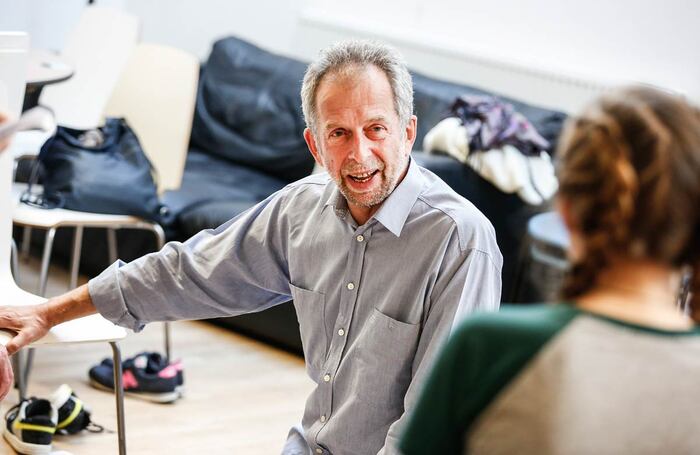
Adrian Jackson. Photo: Pamela Raith

Celebrating its 30th anniversary this year, Cardboard Citizens makes theatre with and for homeless people, and has been at the vanguard of work seeking social change since its inception. Founder and artistic director Adrian Jackson tells Kate Wyver about the influence of his close friend Augusto Boal, the company’s outreach work during the pandemic and its continuing quest

FacebookTwitterLinkedIn

Throughout the 1980s and 1990s, the tunnels and walkways next to London’s Waterloo Station became a temporary home to several thousands of people. Named Cardboard City after the flimsy boxes most beds were made of, the amorphous makeshift settlement was a very visible sign of inequality in Britain.

It was under these arches, where the BFI Imax cinema now sits, that theatre company Cardboard Citizens put on one of its first performances in 1991 to an audience of 60. Most were residents of Cardboard City, and the production was staged by a burning brazier, accompanied by the scampers and snuffles of a dozen or so dogs. “They had arranged a little theatre space on pallets,” founder and artistic director Adrian Jackson remembers, “with a seat of honour for the local vicar. Everyone was very jolly for various reasons.” The company performed a participatory show that involved the audience getting on stage. “It was an extraordinary night.”

Thirty years on, Cardboard Citizens is a world-renowned theatre company, making work that aims to destigmatise and raise awareness of homelessness. Through its community-led approach, the company is an active demonstration of theatre being used to create significant impact and tangible change. It has collaborated with the Royal Shakespeare Company and English National Opera, and is proudly represented by high-profile ambassadors Kate Winslet, David Morrissey and Rory Kinnear. At the start, Jackson says, “we had no idea – we were just a bunch of well-meaning lefty kind of people”. That the company is still going strong is “beyond my wildest dreams”, he adds.

Continues...


Related to this article

Backstage: Cardboard Citizens – turning homeless hostels into theatresBackstage: Cardboard Citizens – turning homeless hostels into theatres
Cardboard Citizens founder Adrian Jackson to leave company after 30 yearsCardboard Citizens founder Adrian Jackson to leave company after 30 years
CathyCathy
Homelessness among actors not uncommon – your views, June 6Homelessness among actors not uncommon – your views, June 6
Study investigates how arts can help the homelessStudy investigates how arts can help the homeless

Jackson, Kate Winslet and Rory Kinnear at Cardboard Citizens’ 25th-anniversary fundraising dinner in 2017. Photo: The Other Richard
Mincemeat, staged at Cordy House, Shoreditch in 2009. Jackson cites the immersive show as a hallmark of the company’s work. Photo: Alastair Muir

Cardboard Citizens primarily works with actors with lived experience of homelessness. “It’s a sort of founding ethos,” Jackson says. “It gives people power in telling these stories. We never have anybody tell their own story, but the audience projects that meaning on to people. If that’s an audience in a hostel, they say: these are people like us, I believe them. I’m not being talked down to, I’m not being told how to live my life. This is just a bunch of people like me, telling a story like I have lived.”

This authenticity is crucial. “Sometimes the stories of homeless people are so exoticised or othered or made into pure victims,” Jackson says. “But ‘homeless’ is a broad topic. It is a very naked state, because we need ‘home’, but in that state everything that happens to people when they are housed also happens [to homeless people]. So it’s not that your life is about homelessness. Homelessness is a condition in which people live their lives: everything from love affairs to grief to triumph and joy and beauty. All of those things happen.”

The stories Cardboard Citizens chooses to tell attempt to reflect this variety and complexity, far away from the common tropes and misconceptions often dramatised.

Origins and influences

That Cardboard Citizens is an example of theatre as both community and comfort stems from Jackson’s own experience of art. “I became somewhat lost in my late teens and for much of my 20s,” he says, “and I experienced a high level of displacement because I didn’t live at home from the age of 15 onwards. My mother died, my father was an alcoholic, and I couldn’t live with him. I really didn’t know what I wanted to do or where I wanted to go for a long time. Theatre was always the place I went back to.”

Continues...


Q&A Adrian Jackson

What was your first non-theatre job?
Plucking turkeys at Christmas.

What was your first professional theatre job?
|Touring The B Team Mysteries with a company called Platypus in the West Midlands.

What do you wish someone had told you when you were starting out?
Don’t worry, you’ll find your niche.

Who was your biggest influence?
Augusto Boal. But also Peter Brook. I used to do an annual pilgrimage to his theatre [in Paris].

What advice would you give to young directors?
Find the stories you’re best placed to tell, and find the people you can tell them with.

Do you have any theatrical superstitions or rituals?
No.

What have you been watching in lockdown?
My prime recommendation is a Turkish series on Netflix called Ethos, which is the most extraordinary, modern, wide-ranging and beautiful glimpse of humanity – a very unusual animal, studied and careful and performed immaculately. And Schitt’s Creek is a breath of fresh air. Unfortunately I’ve almost run out of episodes to watch now. I’m saving them.


At university, he was spotted walking down a corridor and immediately cast in a play. After that, he laughs, “I didn’t do anything else.” When he graduated, he inherited a small outfit called The Fool’s Theatre Company in Oxford. Harry Gibson had started the company and offered it to Jackson to take over. Jackson ran it for three years from 1981, as well as working sporadically in fringe and community theatre. He then worked briefly with Time Radio, a black-led pirate radio station in Harlesden, before joining London Bubble towards the end of the 1980s.

“That was where Cardboard Citizens was incubated, thanks to [creative director] Jonathan Petherbridge. He saw the potential and that we were doing something important.”

Continues...

Augusto Boal in 2008. Photo: Jonathan McIntosh/Wikimedia Commons

Much of Cardboard Citizens’ work uses techniques developed through Theatre of the Oppressed, ideas created by Brazilian practitioner Augusto Boal. One of the key aspects is forum theatre, in which audience members take to the stage to determine the outcome of events. “It’s a theatre of resistance,” Jackson says. “It wants to empower people and, where possible, hand them the means of production.”

Boal also developed the idea of legislative theatre, which uses theatre to create political change. Cardboard Citizens often uses this technique at the end of its residencies, inviting local councillors to come and see work, and encouraging change in local policy.

’It’s a theatre of resistance. It wants to empower people and hand them the means of production’

Jackson and Boal were close friends. They first met in the 1980s – he first heard about Boal while working at London Bubble – and Jackson began translating Boal’s books into English. He has worked on all but Boal’s very first.

“There was no internet, or very little,” Jackson remembers. “Occasionally I would speak on the phone to him in Rio, and I would be £70 poorer at the end of half an hour. I soon learnt that whenever I asked questions, it would result in another page to translate. He was so stimulated by enquiry. It was a lovely process. He was a great man.” The admiration was mutual; in two of Boal’s books, he addressed Jackson: “When I read your translations, I understand what I really meant.”

The pair frequently taught together in other countries, and Boal gave numerous workshops at Cardboard Citizens. “He was restless. He was always wanting to discover more and invent more and collect more.”

Boal died in 2009. “I miss him terribly. I’d always anticipated, when I was less busy, spending six months or a year in Rio and being with him.” Cardboard Citizens would not be the same without Boal’s impact and ideas.

Adapting to the Covid era

In the company’s 30-year history, there is one production of which Jackson is most proud. Mincemeat was first performed in 2001 and again in 2009, and was the recipient of an Evening Standard award for its design. An immersive production, it told the story of a homeless Welsh miner whose body was used and exploited in a Second World War espionage operation. “It’s an extraordinary story,” Jackson says, “and it’s a hallmark of a lot of our work, placing an ignored life at the centre of a story. That’s what we do.”

Continues...

Mincemeat at Cordy House, Shoreditch (2009). Photo: Alastair Muir
Hayley Wareham and Cathy Owen in Cathy (2018). Photo: Pamela Raith

Like all theatre companies, what Cardboard Citizens does had to change radically over the past year. “When the pandemic hit, our main priority was the welfare of our members.” The company realised that members were keen for the usual activity to continue as far as possible. “They wanted us to do what we’re good at, to use theatre as a way of talking about life, as a way of working out who we are in this world, and how it could be different,” he says.

Jackson sees his role, and that of the company, as the same as ever: finding a balance between offering support and facilitating the creation of new work.

At the beginning of the pandemic, members of Cardboard Citizens started reading Daniel Defoe’s A Journal of the Plague Year together. “It’s been a haven for a lot of people.” They come together once a week to check in, chat and read together. When we speak in February, they’ve almost reached the end of the book. “After some hiccups, a lot of members have engaged with us,” Jackson says. “Sometimes we’ve had to help with buying people data on their phones, or sorting out technical difficulties, which is the same way we would pay people’s travel to come to workshops in the real world.”

The plan is to make six short films, interspersing readings of Defoe with members’ journals, which they have been encouraged to keep over the crisis. “That will be our document of the Covid year.”

Outreach

The company has also been extending its reach by working with residents in hotels under the government policy ‘Everyone In’. “It’s remarkable really. A huge amount of people have been taken off the streets, including those who have no recourse to public funds, people who are undocumented and are now housed in hotels in quite a civilised way.”

The policy, he says, has proved what is possible in politics. “The government has shown that we can house these people, and when people are housed and treated in a civilised way, they can put together elements of their lives that have fallen apart. They can take a breather. All the underlying issues that homelessness exacerbates can be dealt with.”

The company’s latest project – Here. Us. Now. – tackles the subject of contemporary social housing. It was inspired by the work of 1980s verbatim journalist Tony Parker and the Grenfell Tower disaster, which tragically illustrated the lack of governmental care for those living in council housing.

“Grenfell was a terrible thing, for which many people in government are responsible,” Jackson says. “One of the things it has taught us is the strength of those communities, of people living on housing estates in London. [They are] really ignored, but are actually an incredibly powerful social group.”

’We’re very conscious of not stealing or colonising stories. They remain very connected to the people who told them’

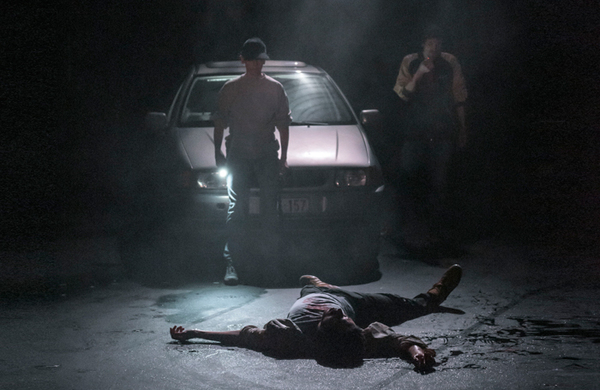
In the aftermath of the fire, Cardboard Citizens performed Cathy, a forum-theatre version of Ken Loach’s Cathy Come Home, in an underpass near Grenfell. Written by Ali Taylor, the show had originally been made for the 50th anniversary of the film, and looked at spiralling housing costs and the pressures of forced relocation.

“We met a number of survivors of Grenfell,” Jackson says. “I admire their grit and determination. Their anger. Not nearly enough has changed. It should have been an earthquake. We await somebody to really remember that social housing is critically important.”

For Here. Us. Now., Cardboard Citizens trained a number of its members to become interviewers and researchers. They went to three London housing estates in pairs, knocking on doors and asking if residents were happy to be interviewed. “Many of our members have experienced vulnerability in housing, and some live in social housing,” Jackson says. “So they were quite close to the people they were interviewing. I think people opened up in a way they might not have to a standard BBC interviewer.”

Continues...


Adrian Jackson on…

Augusto Boal:
“He knew he had discovered something wonderful. He started out as a hungry young theatre director and sort of fell upon this way of combining activism and the power of theatre. The more ‘standard’ theatremaking side of his life rather fell away, a little to his sadness. We got him to Stratford in the late 1990s to do an extended workshop on Hamlet, using his techniques for looking at internalised oppression. He always wanted Stratford to invite him to direct a production of Hamlet, which never happened.”

The early days of Cardboard Citizens:
“Obviously we made mistakes. We probably didn’t fully understand the enduring trauma of the experience of homelessness. I think we might have been more frightened or timorous about exploring certain stories at that time if we had known more than we did then, or if we had been using a less activist form of theatre.”

The company’s plays:
“They are not about homelessness. They are about people, and a lot of them are about what happens to people before or after or during a period in their lives when a lot has fallen away from them.”


The research process culminated in live performances on each estate, using ‘headphone verbatim’, whereby the actor speaks the words coming into their ear half a second after hearing them.

John Watts, an actor in Here. Us. Now., and a member of Cardboard Citizens for the past seven years, remembers the live event. “There was a young girl in the audience,” he says. “Classic bored teenager, until the lights went on in her eyes when she realised it was her voice. She later turned up to some of the workshops Cardboard was running on the estate, and said she hadn’t realised that she had a voice.” At moments like these, Watts says, “you realise how important these projects are”.

Wanting a way to document the research, Jackson recruited Dorothy Allen-Pickard, “a tremendously talented young filmmaker”. Allen-Pickard is a founding member of Breach Theatre and winner of best UK new director at BFI Future Film Festival in 2019. The project has resulted in a collection of short films, with Cardboard Citizens actors performing the words of residents.

In some of the films, the residents sit with the actors, watching their own words being spoken. The fact that the originators of the stories are present, Jackson says, is about ensuring shared ownership. “It’s not taking anything away from anybody, it’s telling the stories with them.” This is something that resonates throughout all the company’s verbatim work. “We’re very conscious of not stealing or colonising those stories. They remain very connected to the people who told them.”

‘New possibilities’

The details of the company’s next project are not yet public, but this will build on its previous work. Set to be put on – pandemic allowing – this autumn, Jackson describes it as “an encouraging story of DIY activism and community creation, which we will need coming out of this terrible time”.

In regular, pre-pandemic times, Jackson travels frequently to teach the Theatre of the Oppressed. He also recently made a film for Artangel called Here for Life, the distribution of which has been interrupted by Covid. Otherwise, he says: “The vast bulk of my past 30 years has been within Cardboard Citizens. It has just kept changing and growing, with new possibilities and people.”

When the company began in 1991, homelessness was “really in your face”, Jackson says. “It was a time when politicians made speeches about stepping over homeless people on their way to the opera. It was before notions of social inclusion.” There were notable gains throughout the 1980s and 1990s, and he notes that the conditions of hostels have improved, as has “the humanity with which people who’ve experienced homelessness are treated”. But he suggests we are almost back to a similar situation now.

The charity Crisis has reported that over the past five years homelessness has risen year-on-year in England, reaching a peak just before the pandemic, when Shelter estimated there were 280,000 homeless people in England. “There’s a better public understanding and some conditions have improved,” Jackson says, “but the bare fact that, in the sixth-richest industrialised nation in the world, this should continue, is obscene.”


CV Adrian Jackson

Born: Village outside Oxford, 1956
Landmark productions:
• The Beggar’s Opera, co-production with English National Opera at Wilton’s Music Hall, London (1999)

• Pericles, co-production with Royal Shakespeare Company at the Warehouse, London (2003)
• Mincemeat, Cordy House, Shoreditch (2009)
• The Glasshouse by Kae Tempest, the Albany, London (2014)
• Cathy by Ali Taylor, Pleasance Theatre, London (2016)
Awards (Cardboard Citizens):
• Best design (by Mamoru Iriguchi), Mincemeat, Evening Standard Theatre Awards (2012)

• Best digital campaign (Citizens Do), National Campaigner Awards (2019)


cardboardcitizens.org.uk

Big Interviews

Adele Thomas and Sarah Crabtree
“We’ve wondered whether we should go dark for a period of time”

Adele Thomas and Sarah Crabtree

Nikolai Foster
“Being an artistic director forces you to grow up quickly”

Nikolai Foster

Jessica Swale
“Compared with other parts of the arts, theatre is so welcoming”

Jessica Swale

Bryony Kimmings
“Theatre is not a game for people who need to pay the mortgage”

Bryony Kimmings

Julie Hesmondhalgh
“Art has an important part to play in changing attitudes”

Julie Hesmondhalgh

Elizabeth McGovern
“Doing theatre meant I could hold my own on Downton Abbey”

Elizabeth McGovern

Sutton Foster
“I know who I am, what I stand for and I look forward to bringing theatre back”

Sutton Foster

Carrie Hope Fletcher
“If our industry is worthless, turn off Netflix”

Carrie Hope Fletcher

Julian Bird
“Our place in the world is at risk. It’s as grave as that”

Julian Bird

Nancy Carroll
“As long as my body serves me, I want to use it. It’s my tool bag”

Nancy Carroll

Your subscription helps ensure our journalism can continue

Invest in The Stage today with a subscription starting at just £7.99

The Stage

© Copyright The Stage Media Company Limited 2025

Facebook
Instagram
X
Linked In
Pinterest
YouTube