


Access Industry: apprenticeships can help solve technical skills crisis



In recent years, the performing arts industry has been suffering from a severe skills shortage in technical backstage roles, a crisis greatly exacerbated by the exodus of workers into television, film and other industries prompted by the Covid pandemic, as well as by the chronic underfunding many arts organisations in the UK have experienced.
Theatres and companies across the country are struggling to fill technical backstage positions, hampering their efforts to produce work to a consistently high standard. It has become crucial for the health of the industry that this problem is addressed. If it is not and the skills shortage persists, then the long-term future of theatre is at risk.
Fortunately, Access Industry can provide theatres with a solution: apprenticeships.
“The performing arts industry has taken a massive hit when it comes to technical skills because of Covid and because of the challenging funding situation,” says Katie Bambridge, Access Industry’s head of apprenticeship sales. “A lot of theatres and arts organisations can solve those problems themselves with an apprenticeship, though.”
Access Industry, formerly National College Creative Industries, is a nationwide training provider that delivers apprenticeships across a range of industries, with connections to hundreds of businesses and organisations across the country. Within the performing arts, Access Industry has worked regularly with the Royal Opera House, Disney and others.
Two of Access Industry’s apprenticeship programmes are focused on developing technical skills and qualifications in the performing arts: the Creative Venue Technician apprenticeship and the Live Event Technician apprenticeship.
Access Industry partners with theatres, companies and other arts organisations to deliver these apprenticeships. Over 18 months, apprentices spend some of their time studying at cutting-edge campuses in Birmingham, Bristol, Lincoln, London, Norwich, Manchester or Plymouth. For the majority of the programme, though, apprentices learn on the job with their employer.
After an end-point assessment, apprentices finish with a Level 3 qualification in their chosen field.
“Perhaps they will stay on with their employer as a full-time member of staff,” Bambridge explains. “Perhaps they will go freelance. Technical training can lead you in all sorts of interesting, exciting directions. We’ve had technical apprentices working on the European tour of The Lion King. We’ve had technical apprentices working on a Beyoncé concert in Paris. We’ve had technical apprentices working in Saudi Arabia.”
Bambridge adds: “Perhaps most significantly, though, apprentices earn while they learn from day one. They do not finish with thousands of pounds of university debt. They finish without any debt and having already been earning for 18 months.”
Continues...
Read More

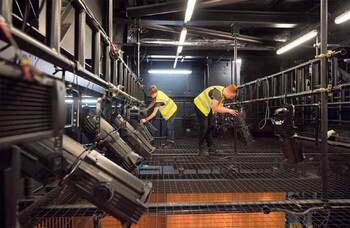


Both the Creative Venue Technician and the Live Event Technician apprenticeships involve the same core elements.
Apprentices on both courses learn the fundamentals of electricals, rigging, lighting, sound, CAD and more, as well as gaining an appreciation of safe working practices, mental well-being, environmental sustainability and the roles played by industry bodies such as the Association of British Theatre Technicians and BECTU.
However, each course has slightly different specialisms. The Creative Event Venue apprentices focus on the skills required to set up and operate a show in a performing arts venue, while the Live Event Technician apprentices focus on the skills required to organise and run an event in a non-traditional space, such as a festival or a conference hall.
“Both courses furnish apprentices with all the technical and professional skills they need to work in the performing arts and events industries,” explains Bambridge. “And, after completing both courses, apprentices will be able to pursue a range of careers.”
What’s in it for employers? The benefits of taking on an apprentice are myriad, says Bambridge. Not only do employers gain an enthusiastic team member who can start plugging gaps in their organisation straight away, but they are also simultaneously doing their bit to develop a loyal, sustainable and diverse workforce.
“I speak to a lot of people in the industry,” says Bambridge. “They all say that they have gaps in their organisation that they need to fill, but that they simultaneously want to invest in developing their workforce and take steps to ensure their staff come from a wide range of backgrounds. With apprenticeships, they can do all three at once.”
Choosing to partner with Access Industry comes with other benefits, too. Firstly, Access Industry treats every theatre and organisation it partners with individually, tailoring its provision to suit that partner organisation’s particular circumstances. Secondly, Access Industry offers a free recruitment process for any organisation that needs help finding an apprentice, advertising vacancies, filtering applications and facilitating interviews.
Thirdly, Access Industry has a nationwide network of theatres, companies and arts organisations that employers can access and collaborate with. And finally, Access Industry has a proven record of success in delivering apprenticeships.
Continues...

The statistics speak for themselves. Access Industry’s current pass rate for apprenticeships is 100%, meaning that every single apprenticeship facilitated by Access Industry results in an apprentice achieving a Level 3 qualification in their field. And the testimonials from Access Industry’s existing network are equally impressive.
“Access Industry consistently delivers an unparalleled level of excellence in its support [for our apprenticeship programmes],” says a representative of production company PRG. “Its bespoke service not only meets but exceeds our expectations, ensuring a seamless and enriching learning experience for our apprenticeships.”
“Access Industry has supported us from the outset. It was committed to understanding the unique needs of our business and has been on hand at each stage of the process to answer any questions,” said a representative of lighting and video equipment provider 4Wall. “Our apprentices have consistently demonstrated adaptability, teamwork skills and an eagerness to learn, and the curriculum provided by Access Industry has supported our apprenticeship team with the theory and knowledge necessary to thrive in our industry. It has been great to work with Access Industry.”
On top of all those benefits, Access Industry can facilitate funding for apprenticeships, too. Employers must cover an apprentice’s salary, just as they would with any member of staff, but there are several options available to ensure the cost of training is covered.
Bigger organisations with an annual payroll of more than £3 million already pay the UK government’s apprenticeship levy, which is set at 0.5% of their annual payroll and can only be used to fund training from approved providers, such as Access Industry.
Smaller, non-levy-paying organisations can access this funding, too, as bigger organisations can choose to transfer the money in their apprenticeship levy pot to other organisations. Access Industry, with its nationwide network, can facilitate this.
“Employers do not need to worry about funding training,” says Bambridge. “If they are a levy-paying organisation, then they will already have money ring-fenced for funding apprenticeships. If they are not, we can help them access that money via a transfer.”
“Access Industry can facilitate the entire apprenticeship process, from funding to recruitment to delivery,” Bambridge adds. “The solution to the performing arts industry’s skills shortage is here. All theatres and other organisations need to do is get in touch.”
To discuss hiring an apprentice with Access Industry, visit accessindustry.co.uk or email info@accessindustry.co.uk



Why theatre must support global-majority leaders to thrive, not just survive


Why theatre must support global-majority leaders to thrive, not just survive
Most Read
Across The Stage this weekYour subscription helps ensure our journalism can continue
Invest in The Stage today with a subscription starting at just £7.99


© Copyright The Stage Media Company Limited 2026


