Whatever one’s spiritual beliefs, the attributes assigned to the Chinese Year of the Horse are aspirations all can get behind. Chinese astrology promises 2026 will bring with it energy, progress and forward momentum.
The new year is still young and freshly minted. But in conversations with sector leaders, it’s clear that the ongoing challenges – financial, artistic, political, national, local – continue unabated. On top of this already unpalatable mix is the global context: just weeks into the year, political unrest and large-scale violence dominate our news feeds – and there is a real and palpable sense of pending war, be it physical or economic, that feels ever closer to home.
Forward momentum is not always positive. Paying attention to global news events is, researchers believe, leading to what’s been termed ‘headline stress disorder’ – the anxiety and overwhelm caused by the scale and volume of negative, frightening global news. These feelings have become particularly prevalent in the era of 24/7 news cycles and social media, where people are constantly confronted with global crises that feel beyond their control.
Continues...
Despite the global context, theatre’s forward motion can be positive – and hope and optimism is what’s needed to counteract our feelings of paralysis and powerlessness.
Theatre has a dual role to play in responding to the polycrisis, and to headline stress disorder: by responding through new writing to global events, and in providing space and sanctuary for audiences to convene.
World events have, in the past, given birth to great new writing, in circumstances of existential terror, much like those we are experiencing now. There’s no reason why our current times shouldn’t yield similar fruit.
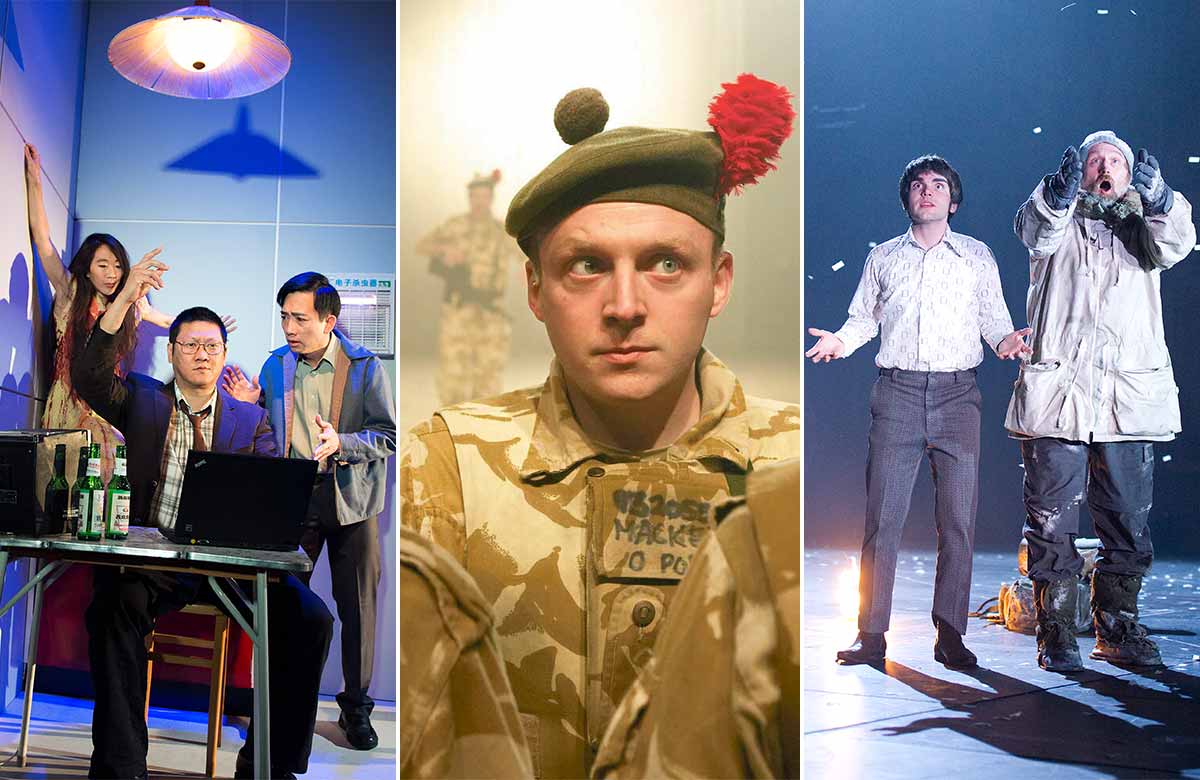
There are many examples: back in 2013 Lucy Kirkwood’s Chimerica deployed the events behind the 1989 Tiananmen Square massacre to examine 21st‑century US–China relations, media ethics and global capitalism, just as the UK tipped from wariness to full-scale suspicion of China’s global economic ambitions. Gregory Burke’s Black Watch some years earlier explored the ethics of the UK’s role in the invasion of Iraq – and was written in a similar national atmosphere of existential terror. Theatremakers’ responses to the climate crisis has, too, been prolific – Greenland (penned by Moira Buffini, Jack Thorne, Matt Charman and Penelope Skinner) being one of many.
Nor is great writing about global events necessarily polemic: Talene Monahon’s Off-Broadway hit Meet the Cartozians, is the smartest takedown of the both the commercialisation and erasure of cultural and ethnic identity currently being staged. Bleak as it may seem, the old adage of living in ‘interesting times’ does and can produce great new works – and the mechanisms of supporting new writing (seen in the refreshed strategy of the Royal Court in London, New Earth Theatre and Birmingham Hippodrome’s Theatre Makers Academy Programme, Mercury Theatre’s Playwrights Development Programme and elsewhere) suggests the sector is very much up for giving ballast to writers’ ambitions.
‘In our ‘interesting times’ it’s well worth dusting off the learning we acquired in lockdown to prepare for what may lie ahead’
New writing can help people make sense of the world – but theatremakers also have the choice to provide the escapism audiences may prefer to pursue in order to dial down personal anxiety. British Theatre Consortium’s research on theatre pre- and post-pandemic certainly suggests that an apparent rise in commercially driven, ‘familiar’ productions and in musicals can be put down in part at least to audiences’ need for an emotional comfort blanket.
But as we saw during the pandemic, theatre can provide more than escapism, and can lean into its role as a civic space of support and sanctuary. In our ‘interesting times’ it’s well worth dusting off the learning we acquired in lockdown to prepare for what may lie ahead.
Social isolation and misinformation, sharply divergent viewpoints expressed digitally and then spilling out into real world behaviours – the hallmarks of our lockdown experiences – are still in play, and, set against a context of growing anxiety and global violence, it’s possible that these trends may become heightened.
Those lessons of compassionate listening, trauma-informed care, creation of sanctuary and practical community support may well once more be required at the forefront of theatre work and theatrical experiences. Those theatres caught in the cross hairs of the recent summer race riots will have deployed all these strategies and more in recent months – indeed, for most, it will have by now become business-as-usual activity.
Theatre leaders, in the months ahead, will be navigating not only their onstage needs but also how their theatres connect with audiences and communities at times of acute anxiety. For every audience member who wishes to look away from the horror and have around their shoulders the blanket of a feel-good show, there will be others who will benefit from a compassionate spirit guide to make sense of what’s unfolding locally, nationally and globally. Momentum may not always be pleasant, but theatre can ensure that we prepare – and move forward with hope and optimism.
Invest in The Stage today with a subscription starting at just £7.99