


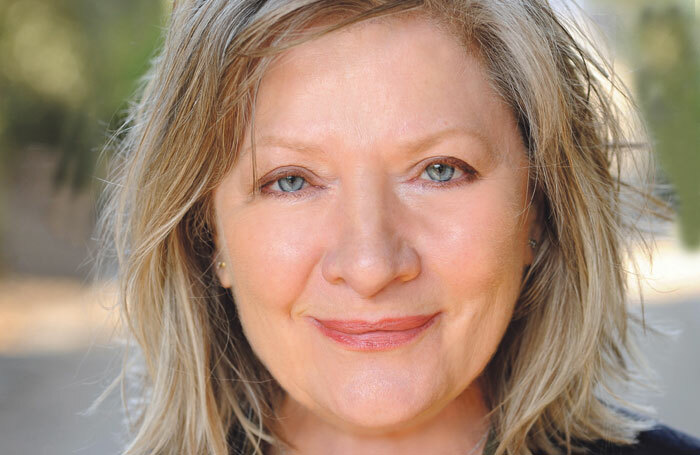
Designer Hildegard Bechtler: 'We were either going to kill each other or have a really good time'


Not only is Hildegard Bechtler one of our busiest and most sought-after stage designers, but she also has an uncanny knack of associating herself with hit shows.
Maybe knack isn’t the right word, since she clearly chooses to work with the country’s finest directors – Roger Michell, Tom Cairns, Robert Icke and Deborah Warner to name a few – whose productions invariably garner rave reviews.
Michell’s production of Nina Raine’s new play, Consent, currently at the National Theatre, is a case in point, as was Icke’s modern-dress Hamlet at the Almeida Theatre in London, which transfers to the West End in June.
It has been a particularly busy couple of years for German-born Bechtler, with back-to-back shows, including The Exterminating Angel, a co-production between the Royal Opera House, Salzburg Festival and New York’s Metropolitan Opera, directed by designer-turned-director Cairns.

She says: “Tom was the only director I’ve worked with who used to be a designer. Before we started working on it, he said to me: ‘We’re either going to kill each other or have a really good time.’ Luckily for me, it was the latter. Actually, the fact that Tom is also a designer made him more respectful of my role. We’ve developed a brilliant kind of shorthand.”
Bechtler’s reason for becoming a designer in the first place, after graduating from the stage design course at Central Saint Martins in London, was because it was a more social alternative to fine art. “I realised early on I didn’t want to be left to my own devices. I wanted to be with other people. You have times when you are alone with your thoughts and creative instincts, but in the end the language you use on stage comes from communicating with your collaborators, principally the director.”
She met and married the actor Bill Paterson early on in her career when she was trying to negotiate a move from film, where she had been working for five years, into theatre. “When I started out in the mid-1980s it was an exciting time, with Channel 4 starting to make films and a lot of young directors coming up,” she says.
Despite both having busy working lives, they started a family straight away. “It was impossible to be away on location with two small children, especially as Bill was often away on location as well, so I had to make the decision to change my working life.”
She once told the Independent on Sunday: “It’s difficult for [Bill] to be with a busy person like me. Many men wouldn’t put up with what he has. After two years I gave up doing film, but it’s difficult to turn down Don Giovanni at Glyndebourne.
“I thought working in the theatre would allow me to have a life and I love the fact that in the theatre you are more in charge of the process and the final outcome. You also have the luxury of time to contemplate and refine your design.”

This is certainly true of The Exterminating Angel, one of the most technically challenging jobs she has undertaken, a joint production between three opera houses with a budget to match. It opened in Salzburg in summer 2016, played Covent Garden this spring and moves to New York and the Metropolitan Opera in October.
Based on Luis Bunuel’s 1962 surrealist film about a dinner party from which there is no escape, Thomas Ades’ third opera mocks the grand opera genre both musically and visually, with Bechtler’s take on 1960s style and couture very much a part of the satirical motif. The Sunday Times review called it “a brilliant affair that held the audience captive like the dinner guests”.
London was still swinging when Bechtler first arrived here aged 18 in 1970. “I was only meant to be coming to London for six months because my parents did not approve, but I loved it so much I had to work out a way to stay. I was of that generation of Germans who felt enormous guilt about what happened in the war. I was very conscious of that.
“Though it was never discussed, it was one of the reasons I wanted to leave Germany. I never once experienced any prejudice against me for being German when I came here. It was the most exciting time to come to England.”
At the start of her stage-designing career, Bechtler worked mostly with the directors Deborah Warner and Tim Albery, dividing her time equally between drama (Warner) and opera (Albery). “The work was always challenging and, with a young family to look after, that was enough.”
Once her kids became more self-sufficient, she began to work with other directors and take on more jobs. “Though it is great to work with people you know and respect, it is exciting to work with different people. I’d never done much Chekhov or Shakespeare, so I jumped at the chance to do The Seagull at the Royal Court with Ian Rickson, which later transferred to Broadway, and also to do Richard II with Deborah and Fiona Shaw, and again at the Old Vic, with Kevin Spacey.”
Last year she did a modern-dress Uncle Vanya at the Almeida, working with the innovative Robert Icke, for which they devised a slowly revolving box, giving the audience shifting perspectives on the action.
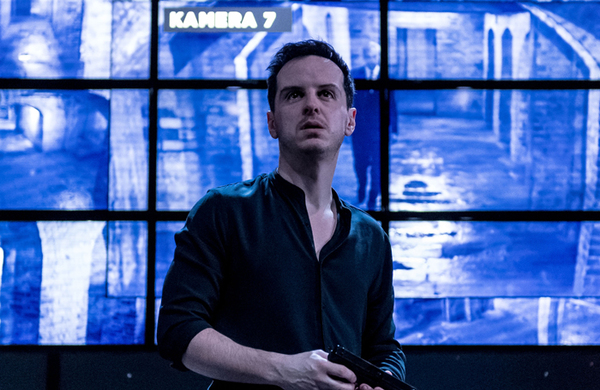
More recently she has worked again with Icke on his modern-dress take on Hamlet at the Almeida, with video designs by the American Tal Yarden. The production uses surveillance cameras and screens to good effect, especially for the ghostly representation of Hamlet’s dead father.

“Tal Yarden is brilliant,” says Bechtler. “I recognised a kindred spirit as soon as we met because of the mixture of stage and screen he has been involved in over the years, like me. My instincts are usually good about collaborators. When you’ve worked well with a person it inspires you to work with them again.”
But it’s not been all classics and opera. Bechtler enjoyed a foray into the world of big-budget musicals in 2013 with the stage adaptation of Top Hat, for which she created a grand Venetian art deco hotel that was, according to the Daily Telegraph review, “a stylish delight”. The job won her an Olivier award nomination.
Has she ever been completely stumped by a design brief? “I’ve never had to give up on a job, no. But there have been numerous technical challenges and glitches that make life stressful. The revolve for Uncle Vanya at the Almeida didn’t stop rotating for nearly three hours, which meant that the whole design aesthetic was dependent on whether or not it worked properly.”
What would she say are the essential qualities for a successful stage designer?
“You must have plenty of energy, staying power and perseverance. I’m not a jobbing designer. I think like a painter, with complete immersion in the moment.
“You’ve got to like people and want to be part of a team. You also have to be good at working on your own. You have to be brave at times, jumping in the deep end. It’s no good being timid or fearful in this job.
“You need a proper understanding of space and three dimensions. I still rely heavily on my model boxes, made by my longtime assistant, Luke Smith, to help me see how everything is going to work. We made 50 miniature people for the model box of Exterminating Angel because I needed to see how they would fit on the stage.”
CV: Hildegard Bechtler
Born: 1951, Stuttgart
Training: National Film and Television School; Camberwell College of Arts (painting); Central Saint Martins (stage design)
Landmark productions: Iphigenia at Aulis, National Theatre (2004), The Goat, Or Who Is Sylvia?, Almeida Theatre, London; Apollo Theatre, London (2004), Richard II, Old Vic Theatre, London (2005), The Crucible, Royal Shakespeare Company (2006), The Seagull, Royal Court Theatre, London (2007), The Damnation of Faust, English National Opera (2011), Scenes from an Execution, National Theatre (2012), The Sunshine Boys, Savoy Theatre, London (2012), Trelawny of the Wells, Donmar Warehouse, London (2013), The Exterminating Angel, Royal Opera House, London (2017)
Awards: Olivier for best costume design for After the Dance at the National Theatre, 2011
Agent: Harriet Cruickshank at Cruickshank Cazenove
The Almeida Theatre’s production of Hamlet runs at the Harold Pinter Theatre, London, from June 9-September 2
Opinion

Recommended for you

Opinion
Recommended for you
Most Read
Across The Stage this weekYour subscription helps ensure our journalism can continue
Invest in The Stage today with a subscription starting at just £7.99

© Copyright The Stage Media Company Limited 2026


