The in-demand choreographer tells Anna Winter about her latest work The Cellist, a Royal Ballet production about the legendary Jacqueline du Pré, reuniting with its principal dancer Lauren Cuthbertson after first working together when the latter was a teenager, and her personal approach to telling stories through movement
Choreographer Cathy Marston is taking on a musical giant: Jacqueline du Pré. The Cellist, Marston’s first work for the Covent Garden main stage, isn’t so much a biography of the feted performer – whose career and life were cut short by multiple sclerosis – as “a love story where the love is not between two people but between a woman, Jacqueline, and her cello”.
The idea of using a dancer to embody the instrument had its origins in Marston’s version of Les Liaisons Dangereuses, made for the Royal Danish Ballet in 2017. “I try to avoid using props as much as I can. There’s a scene in which you have to establish the character Danceny as Cécile’s music teacher. As an experiment I asked one of the male dancers to become a cello. And it worked immediately. It just took a little coordination with the music and we had the freedom to play with it in a more poetic way.”

When Marston’s sister, a drama teacher, suggested Du Pré as a possible subject for a new ballet (“she’s good at knowing the sort of things that might inspire me”), things fell into place. “I thought: ‘Gosh, there’s my cello ballet.’”
Du Pré’s name is synonymous with preternatural talent and tragic demise (she had to stop playing at 28 and died in 1987 aged 42), but salacious rumour swirls around it too: the 1999 film Hilary and Jackie, as well as the book A Genius in the Family by Du Pré’s sister and brother, allege that the cellist – who was married to celebrated pianist and conductor Daniel Barenboim – had an affair with her sister’s husband. Both works were decried by Du Pré’s friends.
Marston, along with Royal Ballet director Kevin O’Hare, took care to get Barenboim’s blessing for the ballet (“I think it tickled him”) but her creation steers clear of these “controversial aspects”, moving towards a mediation on the blisses and burdens of talent while retaining some biographical detail.
Continues…
What was your first professional theatre job?
Dancing with Zurich Ballet.
Who or what is your biggest influence?
Writers.
What’s your best advice for auditions?
Do your homework. Know who you’re auditioning for.
What would you have been if not a choreographer?
I originally wanted to be a policewoman, then an actress. I actually did a course on life and professional coaching as part of the Clore leadership course. I really enjoyed that. Also, I love to think I could write. I like writing but don’t know if that will be part of this lifetime.
“Barenboim is in there, as well as well as [Du Pré’s] mother, father and sister. It does [incorporate] a biography of Jackie to an extent,” she says. “I use ‘a biography’ because I feel that, having spoken to people who knew her, there are many Jackies: for some she was the artist who tragically got MS, for others she was this smiley, goofy, radiant young woman.”
She continues: “The Jackie I want to uncover is the musician, not in terms of the technical quality of her musicianship, but what it means to be an artist and find your voice. I read a lovely quote in which she said that when she played her first concert it was like a brick wall had fallen down in front of her, that she could suddenly communicate with the world.”
The Cellist is about “the relationship you have with your gift and the impact of its loss on you and the people around you” while also being “the story of a cello’s memories of their player”.
‘As an experiment I asked one of the male dancers to become a cello. And it worked immediately’
Disease is inevitably depicted, although “it’s not a ballet about MS”. Marston’s mother suffers from the condition, so “it’s got a bit of a personal resonance and I wanted to approach it with great sensitivity obviously. We’re looking at it from an experiential point of view rather than a scientific one – how it feels, rather than the exact way the body attacks itself.”
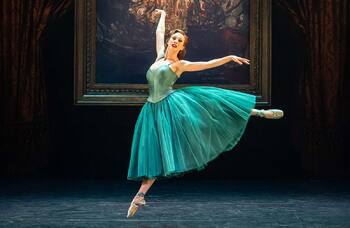
For Marston, principal dancer Lauren Cuthbertson was an obvious casting choice for Du Pré. The pair first worked together in 2002 when Cuthbertson, having just joined the Royal Ballet aged 17, stepped at short notice into the racy central role in Marston’s adaptation of The Go Between, made for the Clore Studio.
“She was so young and naïve, it was a big thing, she did it and was amazing,” Marston recalls of Cuthbertson at the time. “We have this connection. We’ve wanted to work together for a long time.”
Royal Ballet principal Lauren Cuthbertson: ‘I strive to improve, but I’m comfortable with who I am’
Marcelino Sambé is dancing the cello: “His body is so supple, movement just bursts out of him. If you were going to personify music – that’s him.”
It’s impossible to ignore the fact that Marston’s new work is one of very few Covent Garden main-stage commissions made by women. Crystal Pite’s 2017 Flight Pattern was the first such piece for 18 years, followed by Twyla Tharp’s The Illustrated Farewell.
The paucity of female choreographers gaining plum opportunities extends beyond the opera house, of course, but Marston doesn’t want to delve into that discussion: “Why exactly it’s been like that, there are so many reasons. It’s another conversation. Although I think things are slowly changing.”
She notes the support she was given as a budding choreographer by Royal Ballet School teachers Norman Morrice and David Drew. With that in mind, The Cellist is also a personal homecoming. “This has been a long time coming. Of course there’s pressure. I need to step up, hold my nerve and do what I love doing.”
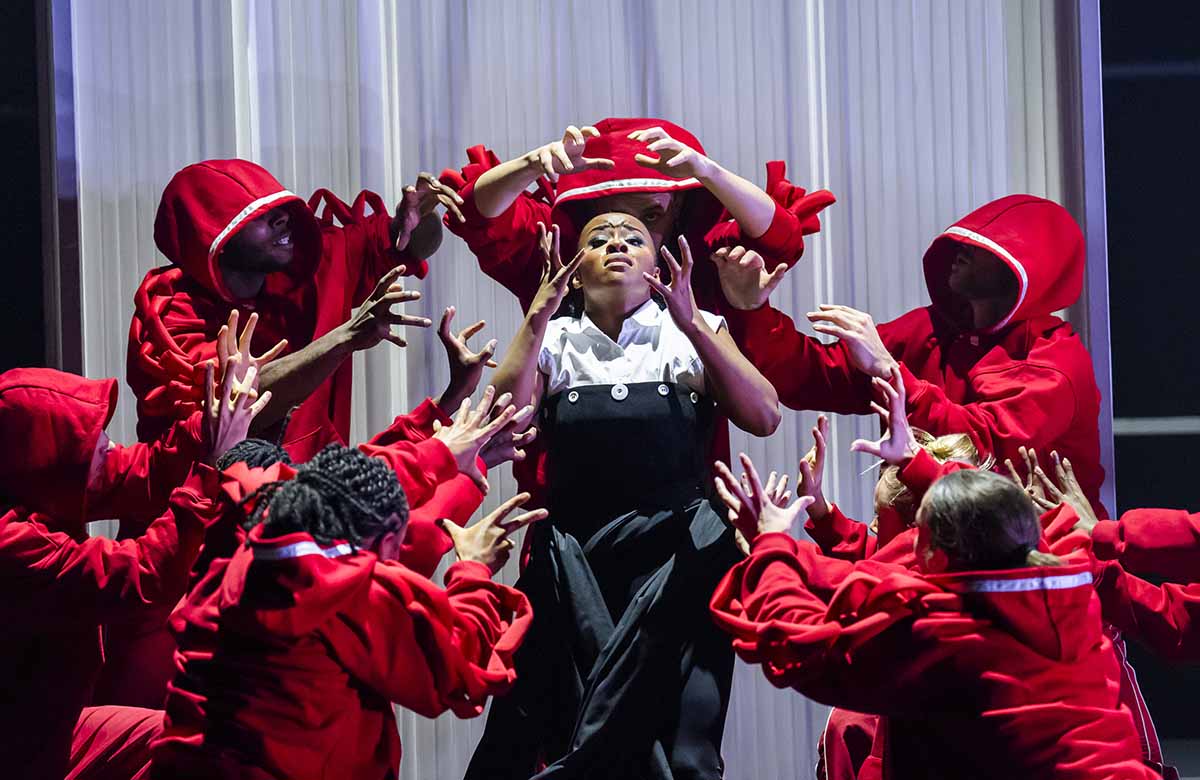
Marston’s no stranger to pressure though, having recently taken on numerous big gigs in America. She received critical acclaim for 2018’s Snowblind, an adaptation of Edith Wharton’s novella Ethan Frome for San Francisco Ballet, while her version of Jane Eyre, originally created for Northern Ballet in 2016, has just been staged at the Met by ABT and Chicago’s Joffrey Ballet.
Victoria, a co-production between Northern Ballet and National Ballet of Canada, premiered in Leeds last March and will open across the Atlantic next year.
Narrative ballet is having a resurgence, she says, but it’s a form she’s been perfecting for years. “It’s taken quite a long time for me to get to this moment. I’m sure some of that is to do with gender inequality but another thing that’s influenced my journey is that I’ve always been very passionate about stories.
“For a long time that was not cool. It wasn’t the fashion. And somehow things go around and now there’s a real interest in narrative dance. I’ve been doing it for a long time. It’s not easy, it takes a while to find a way in and I found my very personal way to tell a story through movement. I’m getting a lot of offers suddenly.”
As director of Bern Ballett, from 2007 to 2013, she found that European audiences appreciated conceptual Regietheater rather than “old-fashioned” storytelling, featuring the kind of faithful period design found in the MacMillan ballets she grew up with. “It was really formative for me: I learned to question things, make bolder choices and trust my own instincts little bit more – to strip away, make suggestions rather than illustrate.”
Looking ahead, she’ll be unveiling Mrs Robinson, her second work for San Francisco Ballet, which takes the eponymous character “on her own journey” beyond The Graduate.
Which other stories would she love to tell? “I have a whole list on my phone. There’s one in particular I really want to do. But I want it to be at the right time in the right place. It’s interesting – place and time make an enormous difference. There are different audiences wherever you go. I don’t want to change the heart of what I do.”
Born: 1975, Newcastle
Trained: Royal Ballet Upper School, 1992-94
Landmark productions:
• Ghosts, Ballett Basel (2005)
• Jane Eyre, Northern Ballet (2016)
• Hamlet, Ballett im Revier (2017)
• Dangerous Liaisons, Royal Danish Ballet (2017)
• The Suit, Ballet Black (2018)
• Snowblind, San Francisco Ballet (2018)
• Lady Chatterley’s Lover, Les Grands Ballets Canadiens (2018)
• Victoria, Northern Ballet and National Ballet of Canada (2019)
The Cellist runs at the Royal Opera House, London, until March 4
Invest in The Stage today with a subscription starting at just £7.99