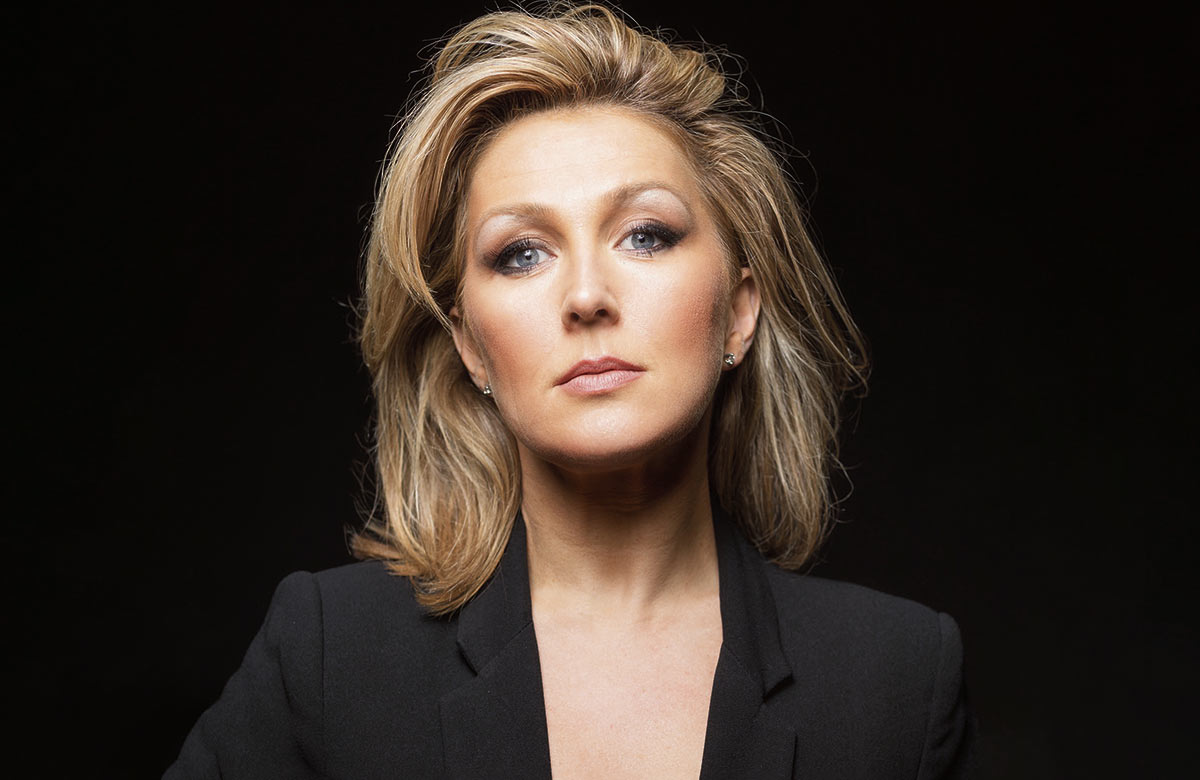
Having spent years performing in Mamma Mia! and the Queen musical, actor Mazz Murray is accustomed long-running shows. She tells Fergus Morgan it’s the unsung heroes, sense of fun and responsibility to audiences that keep the productions fresh
Mazz Murray is trying to work out how many performances of Mamma Mia! she has done at the West End’s Novello Theatre. “There’s 365 days a year,” she wonders aloud. “Take away Sundays and Tuesdays, but then add two for matinees. Oh, I don’t know – 500 at least. Let’s say: ‘over 500.’ It sounds good.”
It is tricky to figure out, partly because of the pauses brought on by the Covid-19 pandemic, and partly because Murray’s lengthy stint in the ABBA musical has been split in two. She first joined in 2015 as Tanya (the role played by Christine Baranski in the 2008 film adaptation), then left in 2017 to join Chicago, before returning in 2019 as Donna Sheridan (Meryl Streep’s character).
“I always wanted to play Donna, ever since I saw Siobhán McCarthy do it originally about 20 years ago,” Murray says. “When I first went into Mamma Mia!, though, I had two young kids and my youngest was only one. The role of Tanya was perfect for me at the time because it is not massively demanding. I couldn’t even have thought about taking on Donna then.”
Murray’s 500-plus performances in Mamma Mia! is not the first time she has spent years with the same show. She was in the original ensemble of the Queen musical We Will Rock You when the show opened in 2002, taking over the role of Killer Queen from Sharon D Clarke in 2004 and staying with it until 2010.
Appearing in long-running shows like Mamma Mia! and We Will Rock You, according to Murray, is a big responsibility – both to the audience in the auditorium and the artists who originated the show’s material in the first place. “You have to do service to the original band, to the original singers and to the original music,” she says. “I felt like I was working for Queen. I feel like I’m working for ABBA.”
“You also have to serve a purpose to the performance that night, and that’s something I take really seriously,” Murray continues. “We get die-hard ABBA fans in. We get die-hard Mamma Mia! fans in. Some of the songs we sing were people’s wedding songs, played at their mother’s funerals or at landmark moments in their life. I feel a real sense of responsibility to them every night.”
The songs in Mamma Mia! are so well-known, in fact, that audience members often sing along or get up and dance – or both. Does that make it difficult to plough on with a performance? “It does bother me when people are rude or just sit there scrolling through their phone,” Murray says. “But I don’t mind people joining in at all. It’s what they’re there for, really. I just want them to have a nice time.”
No matter the importance of the show to some, though, and the weight of responsibility in performing it, being in a long running musical also needs to be fun for the actors. It is the only way that long contracts become bearable, Murray says. And Mamma Mia!, she adds, is one of the most fun shows around.
“Historically, this has always been the party show,” she says. “I think it’s because the cast is predominantly young. There are six adults, and everybody else is a fit 20-something – and they’ve got no clothes on for the majority of the show, too. We Will Rock You was a party show as well. That was absolutely rock’n’roll. It really was debauched. Times have changed since then, though.”
Part of the joy in appearing in Mamma Mia!, Murray says, is down to long-serving stage manager Neil Copley. “He is one of the many unsung linchpins of this musical,” she says. “Every month, he puts on the Mamma Mia! quiz night after a show. There are screens, practical games, votes, drinks and snacks. It’s a really big deal.”
“For every cast, he does a murder-mystery week,” Murray adds. “He devises this game involving pieces of paper and clues. Every night a cast member is ‘killed’, and we have to work out who the murderer is. It’s great fun. Having someone like Neil, who is devoted to keeping things fun for the cast and crew, is absolutely essential.”
And some shows, says Murray, can be funny by accident when something goes wrong on stage. “I dropped a bottle of champagne on my entrance to a bedroom scene once, and it went everywhere – all over the stage,” she remembers. “I just grabbed the bedclothes and carried on with the scene while I mopped the floor.”
Most contracts in long-running musicals such as Mamma Mia! last a year or more. “It would be too expensive to change casts more often than that,” Murray says. “Just one of my Super Trouper costume costs £10,000. Three women need two each – one white, one coloured. That’s £60,000. If all three women were to leave every six months, it would cost a fortune.”
Big West End shows can quickly become “unbearably expensive and financially ruinous” if costs such as that spiral upwards, continues Murray. It is why, when contractual issues arise – such as with the recent closure of Andrew Lloyd Webber’s Cinderella and Equity’s campaign to win compensation for present and future casts – her sympathies are with both producer and performer.
“It is sad that people have lost a year’s income that they were banking on,” Murray says. “The truth, though, is that with big shows, producers face decisions worth millions and millions of pounds. Cast members are just not at the top of their list of priorities. None of us on the shop floor can understand the pressures and stresses that the big boys and girls have.”
Appearing in the same show in the same theatre for weeks, months and even years on end allows actors to develop something relatively rare in the performing arts: a regular routine. Murray’s day starts at 7.30am at her home in Hertfordshire, when she wakes her eight and 11-year-old sons up and gets them ready for school.
“I see them for about half an hour after they get back from school, then I leave for London about 4.30pm,” she says. “I stop off at Starbucks for an enormous caramel macchiato, then I head into the theatre for about 6pm. The warm-up is at 6.15pm. I don’t really do it. I just sit at the back and muck about. Vocal warm-ups are exhausting. I’d only do one if I hadn’t sung for weeks.”
The curtain goes up at 7.30pm and comes down at 10.05pm. If stage manager Copley hasn’t arranged a fun activity for the cast and crew, Murray stops at the stage door on the way out – “I remember being that kid, holding out a programme for someone to sign,” she says – and she can be in bed at home by 1.30am. Repeat. Repeat. Repeat.
“The everyday does become difficult,” Murray says. “I’d rather do one month on, one month off, if I could. I’d love to spend more time with my husband and my children because that’s what is most important to me. Lockdown was lovely, despite everything. I hated home-schooling, don’t get me wrong, but being there with them in the evenings was amazing.”
Invest in The Stage today with a subscription starting at just £7.99