


Innovation Award
The winner and shortlist for the Innovation category at The Stage Awards. Sponsored by Charcoalblue.
This category celebrates exciting new developments in the performing arts across the past 12 months. These can take any form - they can be technological innovations, but they do not have to be. Judges are looking for genuinely new developments and are especially interested in those that help contribute to artistic excellence, strong financial performance, innovative business practices, fair employment/workforce conditions and a commitment to sustainability.
Winner
Hull Truck Theatre
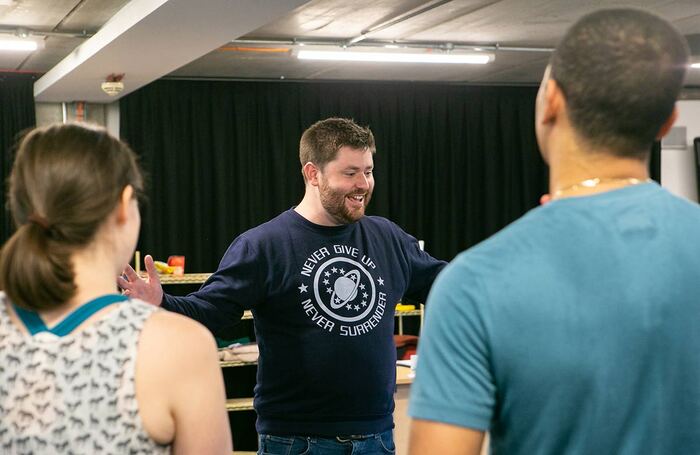
The intersection between theatre and healthcare holds vast potential – despite the two sectors often seeming to be worlds apart. Hull Truck Theatre’s creative learning team, led by associate director Tom Saunders, has tapped into this space of possibility with a theatre-based training scheme for general practitioners.
Partnering with a local NHS branch, the theatre successfully piloted the initiative this year. The project supports qualified doctors undertaking a three-year training programme to become fully qualified GPs. It helps them build essential skills such as communication and empathy, encouraging them to combine these interpersonal skills with their medical knowledge. The drama techniques used in the programme are designed to help GPs express themselves while building confidence to handle complex situations.
The programme comprises six sessions of training each year, tailored to where participants are on their training journeys. Trainee doctors in their first year focus on developing communication skills and simplifying medical jargon for patients. Those in their second year take part in role-play-based exercises alongside empathy training, while third years explore real-life medical scenarios.
The initiative draws on Augusto Boal’s Forum Theatre, which enables participants to try out different actions to change outcomes. Applied to a medical setting, it enables trainee GPs to explore how they might approach challenging consultations by intervening and resetting narratives. Participants are also encouraged to reflect on the implications of their actions.
As a result of the success of this scheme, Hull Truck Theatre has developed a series of other related initiatives to provide training for healthcare professionals. These include bespoke training sessions to manage difficult conversations and conflict resolution, indicating a broad appeal for drama-based training across the healthcare sector.
Alongside the impact of the scheme on future GPs and the patients they will encounter, the initiative has generated an additional £10,000 for Hull Truck Theatre, which it hopes to build on in 2026.
Shortlist

Akhila Krishnan, Zoe Spurr and the Royal Shakespeare Company
Creative video designer and Royal Shakespeare Company interdisciplinary fellow Akhila Krishnan and lighting designer Zoe Spurr co-led a week-long research and development programme with the RSC. The resulting technological discovery opened up exciting new artistic and operational possibilities, with the potential for an industry-wide impact.
Krishnan explored how video design could integrate with an automated follow-spot tracking system, which is technology traditionally used by lighting to track moving performers in order to keep them visible on stage. Working with technical staff and hardware suppliers, the team tested whether video could use this same tracking system for the RSC’s Christmas show. The answer was a resounding yes – with the system now also enabling live lip-syncing between puppets and offstage actors via a video feed to the sound department for the upcoming production of The BFG.
This discovery is the product of a widespread culture of research and innovation being championed by the RSC. Its digital innovation department is pioneering a creative-led approach to technical R&D by providing time and space for experimentation that is separate from production schedules and budgets.
This approach aims to encourage innovation while promoting well-being and fair working conditions for technical and creative staff and freelancers, helping to address long-standing challenges in technical theatre around mental health.
Krishnan’s research empowers designers to use real-time video tracking as a live expressive medium, aligning visuals with movement, lighting and voice in new ways. It moves a string of different tools into a singular, cross-departmental tool, boosting cross-collaboration and improving accuracy in visual storytelling.
There is a financial benefit, too. Integrating video, lighting and sound into a single control network reduces system costs by a third, according to the RSC, making savings across The BFG’s production budget and cutting technical rehearsal time. Using one shared infrastructure also lowers equipment power consumption, reducing environmental impact.
Hull Truck Theatre
The intersection between theatre and healthcare holds vast potential – despite the two sectors often seeming to be worlds apart. Hull Truck Theatre’s creative learning team, led by associate director Tom Saunders, has tapped into this space of possibility with a theatre-based training scheme for general practitioners.
Partnering with a local NHS branch, the theatre successfully piloted the initiative this year. The project supports qualified doctors undertaking a three-year training programme to become fully qualified GPs. It helps them build essential skills such as communication and empathy, encouraging them to combine these interpersonal skills with their medical knowledge. The drama techniques used in the programme are designed to help GPs express themselves while building confidence to handle complex situations.
The programme comprises six sessions of training each year, tailored to where participants are on their training journeys. Trainee doctors in their first year focus on developing communication skills and simplifying medical jargon for patients. Those in their second year take part in role-play-based exercises alongside empathy training, while third years explore real-life medical scenarios.
The initiative draws on Augusto Boal’s Forum Theatre, which enables participants to try out different actions to change outcomes. Applied to a medical setting, it enables trainee GPs to explore how they might approach challenging consultations by intervening and resetting narratives. Participants are also encouraged to reflect on the implications of their actions.
As a result of the success of this scheme, Hull Truck Theatre has developed a series of other related initiatives to provide training for healthcare professionals. These include bespoke training sessions to manage difficult conversations and conflict resolution, indicating a broad appeal for drama-based training across the healthcare sector.
Alongside the impact of the scheme on future GPs and the patients they will encounter, the initiative has generated an additional £10,000 for Hull Truck Theatre, which it hopes to build on in 2026.
National Youth Theatre and Microsoft
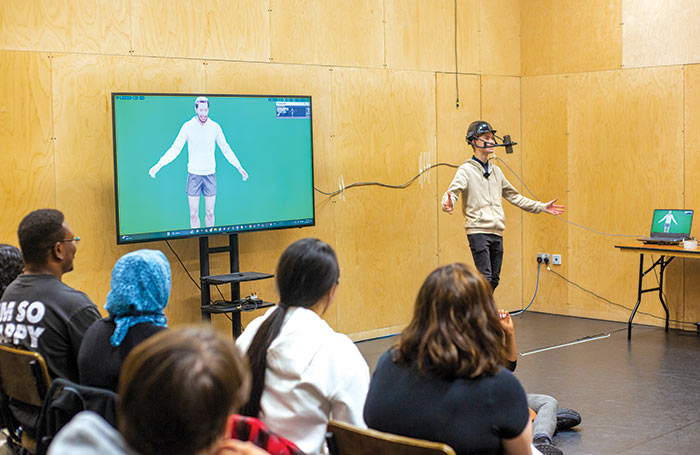
It is impossible to talk about the future of the arts without considering the impact of artificial intelligence. National Youth Theatre and Microsoft have taken a forward-thinking approach to engaging with AI, acknowledging the controversies surrounding it while recognising that it is here to stay.
NYT, in partnership with Microsoft, has launched the UK’s first creative education programme in theatre dedicated to the responsible use of AI. The initiative aims to equip the next generation of theatremakers with the critical skills and ethical understanding needed to navigate an industry that will be transformed by new technologies.
The Digital Accelerator programme, designed in accordance with Microsoft’s responsible AI principles, has empowered thousands of young creatives to explore how AI can enhance imagination, not replace it. Through free workshops led by creative technologists, motion capture performers, film, TV and theatre actors and directors and video and sound specialists, participants have experimented with AI in storytelling, design and performance – while prioritising human creativity.
For example, NYT demonstrated how performers and playwrights could create live scripts from real-time audience suggestions – inventing new forms of interactive theatre that combine technology and performance.
Young people were encouraged to question how data is sourced, who benefits from technological advances and how to reduce the environmental impact of digital creativity.
In its first year, the scheme has had a huge impact in bridging the skills gap between traditional theatre and the digital industries, training 1,504 young people and certifying 383 participants in London, Manchester and Bristol. Meanwhile, more than 355,000 young people engaged with its resources online. The initiative also trained 20 professional creatives as ‘digital accelerator leaders’, providing them with new skills and paid teaching opportunities.
Winners will be announced at The Stage Awards at the Royal Opera House on January 12. Tickets are available to purchase by contacting Sarah DuMay sarah.dumay@thestage.co.uk.
Last Year's Winners
Orchard West Dartford
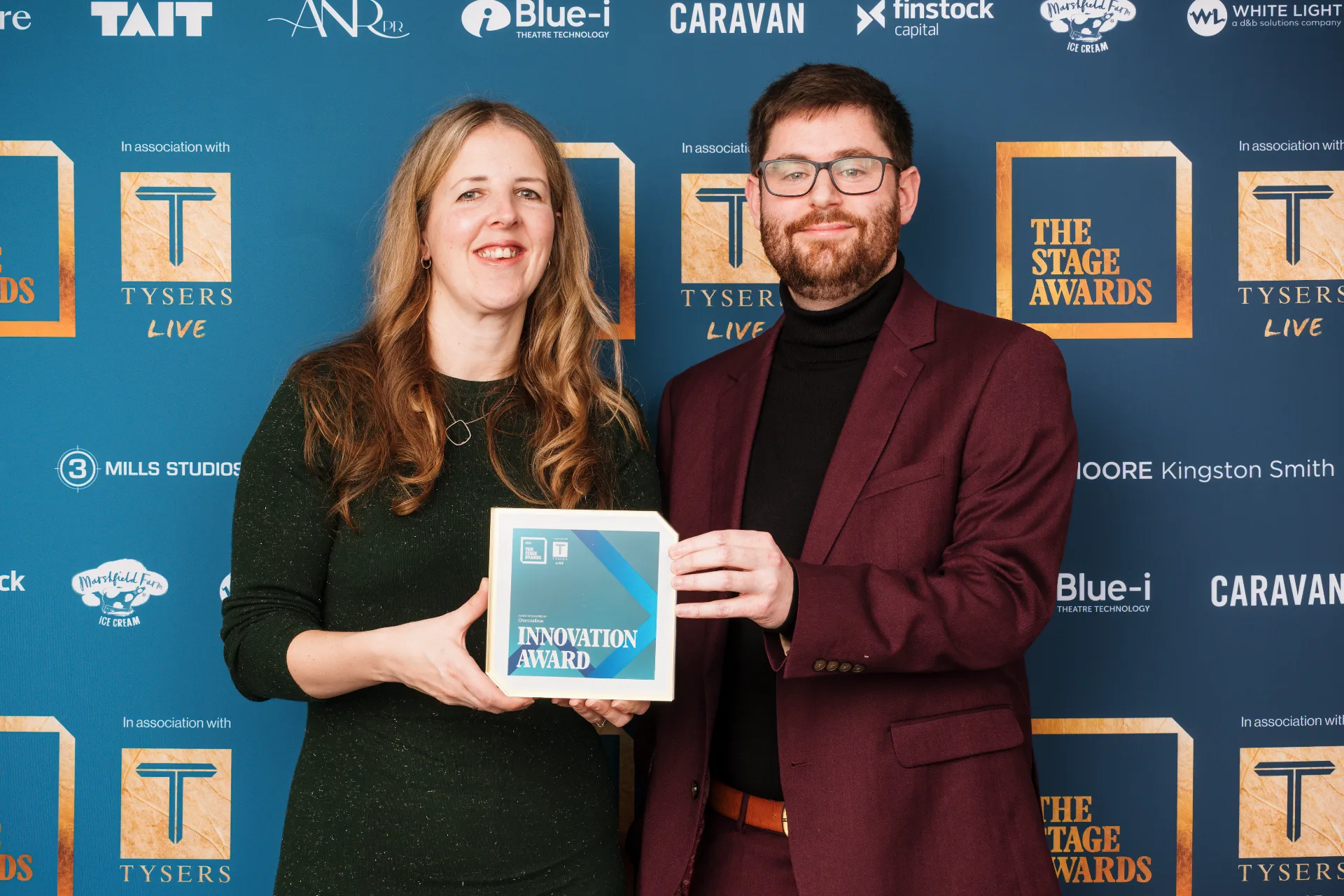
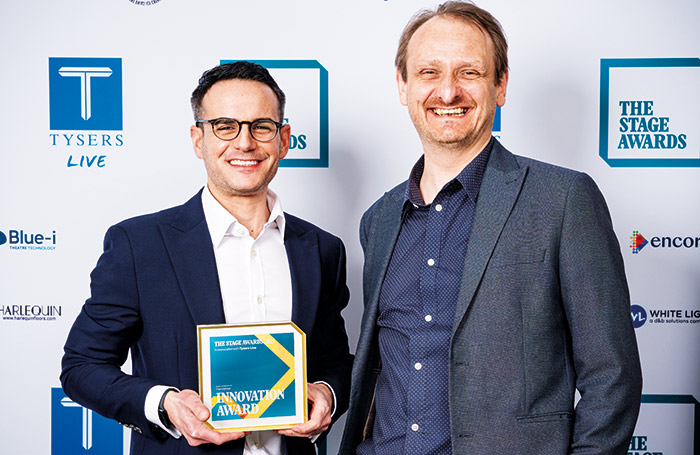
Orchard Theatre director Tal Rosen and Will West, technical and buildings manager, accept the Innovation award
The Stage Awards

© Copyright The Stage Media Company Limited 2026


