As Black British theatre company Talawa celebrates its 40th anniversary, former artistic director Paulette Randall and actor Gary McDonald share their experiences of its first production with Nick Smurthwaite
The spark that lit the flame for Talawa 40 years ago was a commission from the Greater London Council’s Race Equality Unit, requesting “something impressive” from the Black community. On the receiving end of that call was the late Yvonne Brewster, already a respected and accomplished director.
Never one to back away from a challenge, Brewster saw an opportunity to do something on an epic scale, involving many actors and creatives, on one of the vast stages at Riverside Studios.
What she chose to produce and direct was an ambitious adaptation of CLR James’ 1938 book The Black Jacobins, about the Haitian revolution of 1791. The distinguished Caribbean author and historian explores the cruelty and social injustice that resulted in the mass uprising of Black enslaved people, led by the charismatic Toussaint L’Ouverture, played by Norman Beaton, and the abolition of slavery in Haiti.
But first Brewster had to seek James’ permission to stage the play based on his book. She previously explained: “[James] couldn’t immediately compute the situation. Here was this woman, with all this money [£80,000] to spend, wanting to put his play on stage after half a century – only now, at the 11th hour, seeking his permission. Eventually he chuckled, making the point that usually people came along with great, lofty production ideas but no money.”
Brewster added: “I was determined to produce it. This was about the energy of a people trying to be born, as we as Caribbean citizens abroad appreciate only too well. I also wondered about it as a clarion call for people no longer inclined to revolution.”
Continues...
The 23-strong cast included her friend Mona Hammond, with whom she had recently formed the Talawa Theatre Company, along with actors Carmen Munroe and Inigo Espejel. Brewster had already established the Barn theatre company in Jamaica, with Trevor Rhone, two decades earlier, so she knew how to run a company. Talawa is a Jamaican word meaning ‘small but feisty’.
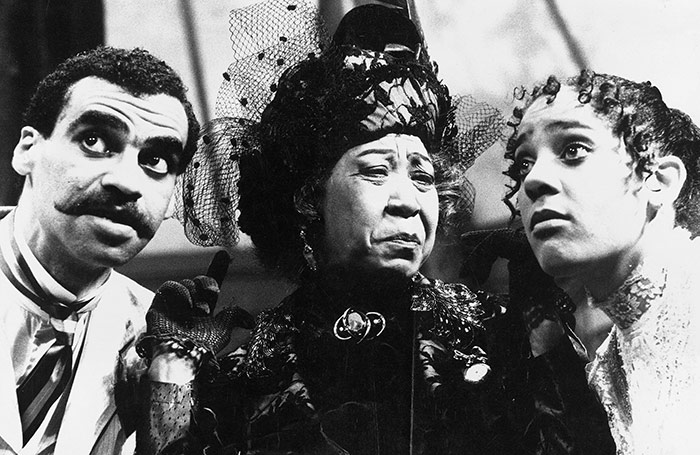
Actor Gary McDonald, one of the original cast, recalls: “It was a vast stage and the supporting actors were on stage the whole time, so you felt involved. Yvonne allowed us to be creative. She never dictated where you were supposed to go, she let you discover it yourself. She had a vision for the bigger picture.”
McDonald went on to do other shows with Talawa, including An Echo in the Bone (1986), an exploration of postcolonial identity, and The Importance of Being Earnest, which played in Newcastle and Cork before coming to London. “I remember having a conversation with one of the other actors, saying: ‘Wouldn’t Oscar be amazed to know we were doing an all-Black version of his play?’ At that precise moment, the light in the room flickered, so we wondered if maybe he was listening.”
Wilde’s grandson, Merlin Holland, came to see the company in London. Afterwards, he told Hammond, who played Lady Bracknell: “You’ve finally laid Edith Evans’ ghost to rest.”
Continues...
“Yvonne Brewster is to step down as artistic director of Talawa, the company which has transformed the role of black theatre in Britain over the past decade. Under Brewster’s leadership, Talawa has been widely acclaimed as the country’s pre-eminent black theatre company through its work in London as well as national and international tours. Brewster will step down in November, after the company’s production of Othello at the Drill Hall.”
One of Brewster’s successors, the writer and director Paulette Randall, saw The Black Jacobins when she was starting out as a director. She recalls: “I’d never seen an all-Black company do something on that scale. In a way, it was a halcyon time for Black theatre, with lots of smaller companies around, like Temba, Tara Arts and the Black Theatre Co-Operative. As a young trainee director, it gave me the opportunity to direct plays.” She continues: “Yvonne played a big part in my life. She made me finish the very first thing I’d written, Fishing, and directed it as part of the first Black Theatre Season at the Arts Theatre. After she left Talawa and it had all gone a bit quiet, I thought maybe I could put it back on the map. I never wanted to run a theatre company, I just didn’t want Talawa to die.”
Die it most certainly did not. Current artistic director Michael Buffong was yet another Brewster protégé who started out as an actor in early Talawa shows such as Flash Trash, a Jamaican reggae pantomime, and a mixed-race Othello.
Why is Talawa still so vital? “It seems disingenuous not to have our own companies,” says Buffong. “We need the ability to tell our own stories.”
Invest in The Stage today with a subscription starting at just £7.99