



Boisterous, refreshingly positive story of male friendship and media bias told from a South Asian perspective



First seen at the Royal Court in 2023, Mohamed-Zain Dada’s thought-provoking comedy is a warm, well-observed exploration of the tight friendships and social pressures experienced by a group of British-Muslim men.
This slightly reworked touring production amps up the humour and the stakes, losing some of the original’s subtlety but making explicit its themes of Islamophobia, media bias and the struggle to carve out a positive version of masculinity.
Taking place entirely in a London shisha lounge, the story centres on aspiring journalist Jihad, who sets out with innocent intentions of making a documentary that celebrates his community. But Jihad’s dream sours when his editors pressure him to twist the facts to fit an all-too-familiar narrative depicting him and his friends as an insidious threat to British life.
Dada’s playful script confronts and refutes the crude stereotypes often imposed upon South Asian men – and, indeed, young men in general. The members of this trio are sincere in their religious faith but not close-minded, respectful towards women and unfailingly supportive of one another.
The dialogue is buoyant, full of slang and snappy banter, but the writing does become heavy-handed in places. White characters are deliberately heightened into sneering, insincere caricatures, literal automatons with synthesised robotic voices. At one point, Jihad breaks into a warped version of A Spoonful of Sugar to satirise workplace policies that claim to encourage diversity without taking on board the contributions or critiques of people from non-white backgrounds.
Continues...
Related to this Review
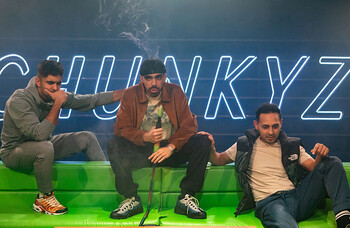
Returning director Milli Bhatia gives the piece an energetic staging that recognisably captures the silliness and boisterousness of young male friendships. The characters play-fight and scramble over the furniture, dancing for joy or sulking when they face troubles. Movement director Theophilus O Bailey takes things further with passages of balletic, symbolic dance.
Tomás Palmer’s set presents the shisha lounge as a square of lime-green couches sunk into a pit between two ramps, with a slanted ceiling suspended overhead that presses down ominously as pressures – social, financial and cultural – weigh heavily on the friends.
Reprising his role as Jihad, Omar Bynon believably balances naivety, ambition and punishing guilt, his body language shifting from relaxed openness to hunched, hyperventilating anxiety. Beside him, Kashif Ghole’s Asif is loveably hapless, spending the play gleefully gossiping and bouncing from one hustle to the next before he encounters betrayal and sees his prospects evaporating.
But it is Azan Ahmed who makes the strongest impression in this production as Rashid, whose troubled past has led him to a place of calm self-awareness. Ahmed projects steady confidence and brotherly affection, encouraging forgiveness and understanding whenever tensions arise; he is a strong, positive role model, anchoring the group despite all the world throws at it.


More Reviews






More Reviews
Recommended for you
Most Read
Across The Stage this weekYour subscription helps ensure our journalism can continue
Invest in The Stage today with a subscription starting at just £7.99

© Copyright Playbook Media Trading Company Limited 2026


